

Your wardrobe is costing you more than closet space. The average person spends 17 minutes choosing an outfit every morning, and that daily friction quietly drains focus before the workday even starts. For urban professionals juggling packed schedules, back-to-back meetings, and a need to look sharp at every turn, that mental overhead adds up fast. Minimalist fashion offers a direct fix: fewer pieces, smarter choices, and a wardrobe that works as hard as you do. This guide breaks down exactly why minimalist style is the highest-leverage move you can make for your daily routine.
Table of Contents
- What is minimalist fashion?
- The science: Minimalist fashion and decision fatigue
- Minimalist wardrobes: Sustainability and cost-per-wear
- Building your functional, versatile minimalist wardrobe
- Risks and misconceptions: Navigating the minimalist aesthetic
- Upgrade your minimalist wardrobe with smart accessories
- Frequently asked questions
Key Takeaways
| Point | Details |
|---|---|
| Decision fatigue reduced | Minimalist fashion streamlines your mornings and frees up mental energy for what matters most. |
| Sustainable and cost-effective | Fewer, higher-quality pieces help the environment and lower your long-term wardrobe expenses. |
| Effortless personal branding | A modular wardrobe ensures your style stays professional, consistent, and flexible. |
| Functional technology integration | Tech-friendly minimalist accessories offer enhanced convenience and security for busy urban living. |
| Pitfalls are manageable | Awareness of common risks allows you to personalize minimalist style without losing individuality. |
What is minimalist fashion?
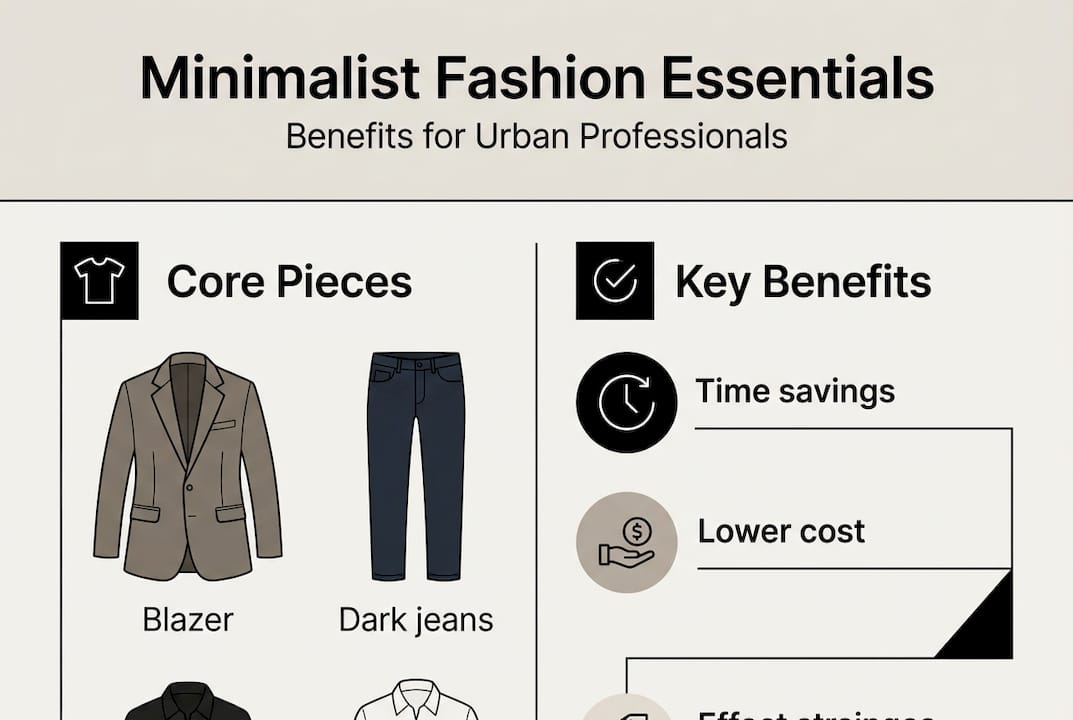
Minimalist fashion is not about owning as little as possible. It is about owning the right things. At its core, minimalism in fashion means building a wardrobe around simplicity, versatility, and intentionality. Every piece earns its place by working across multiple contexts, from a morning commute to a client dinner.
Minimalist wardrobes prioritize high-quality, durable pieces that favor function over trend. That means neutral tones, clean silhouettes, and fabrics that hold up over time. For tech-savvy professionals, this philosophy extends naturally into functional fashion must-haves like RFID-blocking wallets, tech-enabled bags, and performance fabrics that move with your lifestyle.
Here are the core staples of a minimalist wardrobe for urban professionals:
- Neutral-toned tailored trousers (black, navy, gray, or camel)
- Crisp, versatile button-down shirts in white or light blue
- A structured blazer that transitions from office to evening
- Quality denim in a clean, slim cut
- A minimalist tech-integrated jacket with hidden pockets or water resistance
- Slim RFID-blocking wallet to keep your carry lean and secure
- Monochrome sneakers or leather shoes that pair with everything
Think of these as your fashion tech essentials: the building blocks of a wardrobe that performs. Minimalism is not austerity. It is precision.
The science: Minimalist fashion and decision fatigue
Decision fatigue is real, and it hits professionals hardest. Every choice you make throughout the day draws from the same finite pool of mental energy. By the time you have picked an outfit, decided what to eat, and answered a dozen emails, your best thinking is already spent.
Minimalist wardrobes free up mental energy for high-value tasks by eliminating low-stakes decisions before the day begins. This is not a lifestyle trend. It is a performance strategy. Leaders like Barack Obama and Steve Jobs famously adopted near-uniform dressing to protect their cognitive bandwidth for decisions that actually mattered.
“The more decisions you eliminate from your morning, the more mental clarity you carry into your most important work.” — Resilient Wisdom on the Uniform Principle
The numbers back this up. Here is how minimalist and traditional wardrobes compare on daily decision time:
| Wardrobe type | Avg. morning outfit time | Weekly time spent | Annual time lost |
|---|---|---|---|
| Traditional (50+ pieces) | 17 minutes | 1 hr 59 min | 103 hours |
| Minimalist (15-20 pieces) | Under 2 minutes | 14 minutes | 12 hours |
That is over 90 hours a year reclaimed. For professionals who track their time like currency, that number is hard to ignore. Pairing this mindset with convenience-focused fashion trends means your wardrobe actively supports your productivity rather than quietly undermining it.
Minimalist wardrobes: Sustainability and cost-per-wear
Beyond personal benefit, minimalist fashion scales its impact to the planet and your wallet. The fashion industry’s environmental footprint is staggering. Fast fashion accounts for 10% of global carbon emissions and generates 92 million tons of textile waste every year. Meanwhile, people buy 60% more clothes than they did in 2000 but wear each item 36% less.

Minimalist habits directly reverse this pattern. When you invest in fewer, better pieces and actually wear them, textile waste drops by 20 to 30%. That is a meaningful environmental win that also happens to save you money.
Here is a side-by-side comparison:
| Factor | Minimalist wardrobe | Fast fashion wardrobe |
|---|---|---|
| Annual spend | $600-$1,200 | $1,500-$3,000+ |
| Items owned | 15-20 | 60-100+ |
| Avg. cost-per-wear | $2-$5 | $15-$30 |
| Textile waste generated | Low | Very high |
| Outfit combinations | 40+ | Often repetitive |
Tech-integrated minimalist clothing, like the techwear trends for professionals gaining traction in 2026, extends garment lifespan even further. Performance fabrics resist wear, repel water, and maintain their shape across hundreds of uses. Pair that with best smart clothing options and you are building a wardrobe that earns its keep.
Pro Tip: Before buying any new piece, divide its price by the number of times you realistically expect to wear it. If the cost-per-wear is under $5, it is likely a smart investment. If it is over $20, reconsider.
Building your functional, versatile minimalist wardrobe
With the benefits clear, the next step is making minimalist style real and actionable. Building a high-performance wardrobe does not happen overnight, but a structured approach makes it straightforward.
Just 15 to 20 quality pieces can generate over 40 outfit combinations when selected with intention. The key is modularity: every item should pair naturally with at least three others in your wardrobe.
Here is a step-by-step process to get started:
- Audit your current wardrobe. Pull everything out. Identify what you actually wear versus what just takes up space. Be honest. If you have not worn it in six months, it is not earning its place.
- Curate around neutrals. Keep pieces in black, white, navy, gray, and earth tones. These form the backbone of a modular system. Building around neutrals and technical fabrics increases both modularity and longevity.
- Invest in tech-friendly upgrades. Swap out bulky accessories for slim, functional alternatives. An RFID-blocking wallet replaces a stuffed billfold. A tech-enabled bag replaces a generic tote. These upgrades add security and convenience without adding bulk.
- Apply the one-in, one-out rule. Every new piece that enters your wardrobe should replace something leaving it. This keeps your system lean over time.
- Style with intention. Use urban techwear styling tips to layer and adapt your core pieces across seasons and settings.
Pro Tip: Multifunctional accessories are the secret weapon of minimalist dressing. A slim wallet with RFID protection, a jacket with hidden charging pockets, or a bag with built-in organization handles multiple needs without adding extra items to your carry. Explore urban fashion accessories designed specifically for this purpose.
Risks and misconceptions: Navigating the minimalist aesthetic
Even powerful trends have their misconceptions, and minimalist fashion is no exception. The most common criticism is that minimalism equals boredom. That is simply not true when executed well. A perfectly fitted charcoal blazer over a white tee communicates more confidence than a cluttered outfit ever could.
Minimalist designs signal authenticity in professional contexts, though they can occasionally create value ambiguity if the quality of the pieces is not evident. The fix is simple: invest in fabric and fit. Quality speaks for itself up close.
“Quiet luxury is not about invisibility. It is about communicating taste without needing to announce it.”
There is also a misconception that minimalism is socially exclusive or expensive to maintain. Logo-minimal brands are seeing rising search interest, but the minimalist approach is accessible at multiple price points when you prioritize cost-per-wear over sticker price.
Here are the most common myths and how to navigate them:
- Myth: Minimalism means wearing the same thing every day. Reality: A curated 15-piece wardrobe creates genuine variety through smart combinations.
- Myth: You need to spend a fortune to go minimal. Reality: Gradual investment over time, replacing low-quality pieces with durable ones, is the practical path.
- Myth: Minimalist style lacks personality. Reality: Fit, texture, and subtle details express individuality without visual noise.
- Myth: It only works in certain industries. Reality: Minimalist dressing adapts across creative, corporate, and casual professional environments.
For more ideas on personalizing your approach, fashion innovation tips offer practical ways to keep minimalist style feeling distinctly yours.
Upgrade your minimalist wardrobe with smart accessories
For those ready to take minimalist style to the next level, the right accessories make all the difference. A wardrobe built on clean, versatile pieces deserves equally intentional accessories that add function without adding clutter.
At InvisiTechWear, we design accessories and apparel specifically for professionals who refuse to choose between style and security. Our RFID minimalist wallet is built for exactly this lifestyle: slim enough to disappear into a jacket pocket, smart enough to block electronic theft, and refined enough to complement any minimalist outfit. Browse our full range of RFID wallets and bags to find the pieces that complete your wardrobe without overwhelming it. Every product is designed to work harder so your wardrobe stays leaner.
Frequently asked questions
How many pieces should a minimalist wardrobe include?
A minimalist wardrobe typically consists of 15 to 20 interchangeable pieces, which can generate over 40 distinct outfit combinations when selected around neutral, modular items.
Does minimalist fashion really reduce environmental impact?
Yes. Extending a garment’s active use by just nine months can cut textile waste by 20 to 30%, and a minimalist wardrobe naturally encourages longer wear cycles for every piece you own.
Will a minimalist wardrobe limit my style options?
Not at all. Neutral, modular pieces actually maximize outfit variety because they pair freely with each other, giving professionals more expressive combinations from fewer items.
Are minimalist wardrobes more expensive upfront?
The initial investment is higher, but minimalist pieces offer better cost-per-wear over time. A $200 jacket worn 150 times costs far less per use than a $40 jacket worn five times before falling apart.
How do I start transitioning to minimalist fashion?
Start by auditing what you already own, then curate versatile neutrals and gradually replace low-quality items with a few functional, tech-forward pieces that earn their place every day.


