

Navigating crowded city streets, juggling work and fitness schedules, urban professionals face growing demand for clothing that blends style with smart, secure functionality. Connected clothing has shifted from novelty to necessity, merging textile innovation and technology to create garments that integrate biometric sensors and real-time security features. This article explores how these intelligent clothes redefine convenience and personal safety, offering insights for those seeking fashionable solutions that respond to life’s fast pace.
Table of Contents
- What Connected Clothing Means Today
- Key Types And Technology Features
- How Connected Clothing Boosts Security
- Daily Use Cases And Consumer Benefits
- Privacy Risks And Durability Challenges
Key Takeaways
| Point | Details |
|---|---|
| Connected clothing merges fashion and technology | These garments collect real-time data, enhancing health tracking and personal security. |
| Smart textiles have diverse applications | Ranging from health monitoring to environmental sensing, they adapt to user needs and lifestyles. |
| Data privacy and durability are critical | Users should prioritize garments with robust data protection and materials that withstand wear and tear. |
| Choose wisely for comfort and compatibility | Prioritize connected clothing that balances technology with comfort and seamlessly integrates into your digital ecosystem. |
What Connected Clothing Means Today
Connected clothing represents a revolutionary intersection of fashion and technology, transforming traditional garments into intelligent, data-collecting platforms. Smart textiles integrating sensors are redefining how we interact with our clothing, turning everyday wear into sophisticated communication devices.
At its core, connected clothing goes beyond simple aesthetic appeal. These technologically enhanced garments are embedded with electronic components that enable real-time data collection and transmission. Key features include:
- Continuous physiological monitoring
- Real-time health tracking
- Seamless device integration
- Interactive communication capabilities
- Enhanced personal security functions
The technology behind connected clothing leverages Internet of Things (IoT) principles, allowing garments to communicate with cloud services, smartphones, and other digital ecosystems. Biometric sensors can track critical health metrics like heart rate, body temperature, stress levels, and movement patterns, providing users with unprecedented insights into their physical condition.
Connected clothing transforms personal technology from something we carry to something we wear.
Modern connected clothing spans multiple domains, from healthcare to fitness, and even professional environments. Innovative textiles now support electrotherapy, improve blood circulation, and assist in wound healing processes. These smart garments are not just accessories but intelligent companions that adapt and respond to the wearer’s needs.
Pro tip: When selecting connected clothing, prioritize comfort, data privacy features, and compatibility with your existing digital ecosystem.
Key Types and Technology Features
Connected clothing technology represents a sophisticated fusion of textile engineering and advanced electronics, creating flexible electronic systems that transform traditional garments into intelligent interfaces. These smart textiles go far beyond conventional clothing, integrating cutting-edge technologies that enable real-time data collection and environmental interaction.
The primary categories of connected clothing can be classified based on their core functionality and technological implementation:
- Health Monitoring Garments: Track vital signs and physiological metrics
- Performance Tracking Apparel: Designed for athletes and fitness enthusiasts
- Environmental Sensing Clothing: Capable of detecting external conditions
- Safety and Emergency Response Wear: Integrated with alert and communication systems
- Professional and Industrial Smart Textiles: Specialized clothing for specific work environments
Technological Features that define connected clothing include advanced components such as:
- Nanomaterial-embedded conductive fibers
- Flexible wireless communication modules
- Self-powered sensing mechanisms
- Adaptable power management systems
- Breathable and washable electronic substrates
Flexible electronic systems integrated into garments enable unprecedented functionality, allowing clothing to monitor, communicate, and adapt in real-time. These smart textiles can dynamically respond to environmental changes, track physiological data, and provide unprecedented levels of personal interaction.
Smart clothing transforms fabric from a passive protective layer to an active, intelligent interface.
The technological complexity of connected clothing involves intricate design principles that balance functionality, comfort, and durability. Engineers and designers must carefully integrate electronic components without compromising the textile’s core characteristics of flexibility, breathability, and aesthetic appeal.
Pro tip: When exploring connected clothing, prioritize garments with modular electronic components that can be easily updated or replaced.
Here’s a summary comparing the main types of connected clothing and their distinctive focuses:
| Connected Clothing Type | Main Application Area | Key User Benefit |
|---|---|---|
| Health Monitoring Garments | Healthcare and medicine | Real-time health insights |
| Performance Tracking Apparel | Fitness and athletics | Enhanced workout tracking |
| Environmental Sensing Clothing | Outdoor and industrial use | Early hazard detection |
| Safety & Emergency Response Wear | Public safety & security | Automated alerts and location data |
| Professional Smart Textiles | Specialized work settings | Increased safety and productivity |
How Connected Clothing Boosts Security
Continuous monitoring of physiological parameters transforms connected clothing into an advanced personal security system. By integrating sophisticated sensors and communication technologies, these intelligent garments provide unprecedented protection for individuals across various environments and scenarios.
The security enhancements of connected clothing manifest through multiple critical capabilities:
- Emergency Detection: Immediate alerts for unusual health conditions
- Location Tracking: Real-time geographical positioning
- Unauthorized Access Prevention: Integrated digital security mechanisms
- Environmental Hazard Warnings: Instant notifications about potential risks
- Biometric Authentication: Personal identity verification through clothing
For professionals in high-risk environments, connected clothing offers transformative security solutions. Military personnel, emergency responders, and industrial workers can benefit from advanced IoT-enabled protective wear that provides continuous situational awareness and health monitoring.
Smart clothing acts as a silent guardian, constantly protecting and monitoring without intrusion.
Technological Security Features include advanced components that go beyond traditional protective gear:
- Physiological stress level monitoring
- Real-time health status transmission
- Automatic emergency service communication
- Integrated GPS and location tracking
- Biometric authentication systems
The integration of Internet of Things (IoT) technology enables these garments to function as proactive security devices. They can detect potential health emergencies, track an individual’s location, and provide instant communication channels during critical moments.

Pro tip: Select connected clothing with multi-layer security features and ensure regular software updates to maintain optimal protection.
Daily Use Cases and Consumer Benefits
Continuous health monitoring through smart clothing represents a revolutionary approach to personal wellness and lifestyle management. These intelligent garments transform everyday wear into sophisticated health and performance tracking systems, providing users with unprecedented insights into their physical condition and daily activities.
Consumers can experience a wide range of benefits across multiple domains:
- Health Management: Real-time biometric tracking
- Fitness Performance: Precise athletic data collection
- Comfort Optimization: Adaptive temperature and fit regulation
- Stress Reduction: Physiological condition monitoring
- Personalized Wellness: Individualized health recommendations
Practical Applications of connected clothing span diverse lifestyle scenarios, including:
- Professional athletes monitoring training intensity
- Chronic disease patients tracking vital signs
- Workplace safety professionals detecting environmental risks
- Fitness enthusiasts optimizing workout performance
- Individuals managing stress and wellness
Wireless communication and sensor integration enable these garments to provide real-time data transmission and analysis, creating a seamless interface between human physiology and digital technology.
Connected clothing transforms passive garments into active health companions.
The convergence of fashion, technology, and health sciences allows consumers to gain deeper understanding of their bodies, optimize performance, and make more informed wellness decisions. By integrating sophisticated sensors into everyday clothing, individuals can now track heart rate, stress levels, movement patterns, and environmental conditions with unprecedented ease and accuracy.
Pro tip: Select connected clothing that offers comprehensive data insights and prioritizes user privacy through secure data management protocols.
Privacy Risks and Durability Challenges
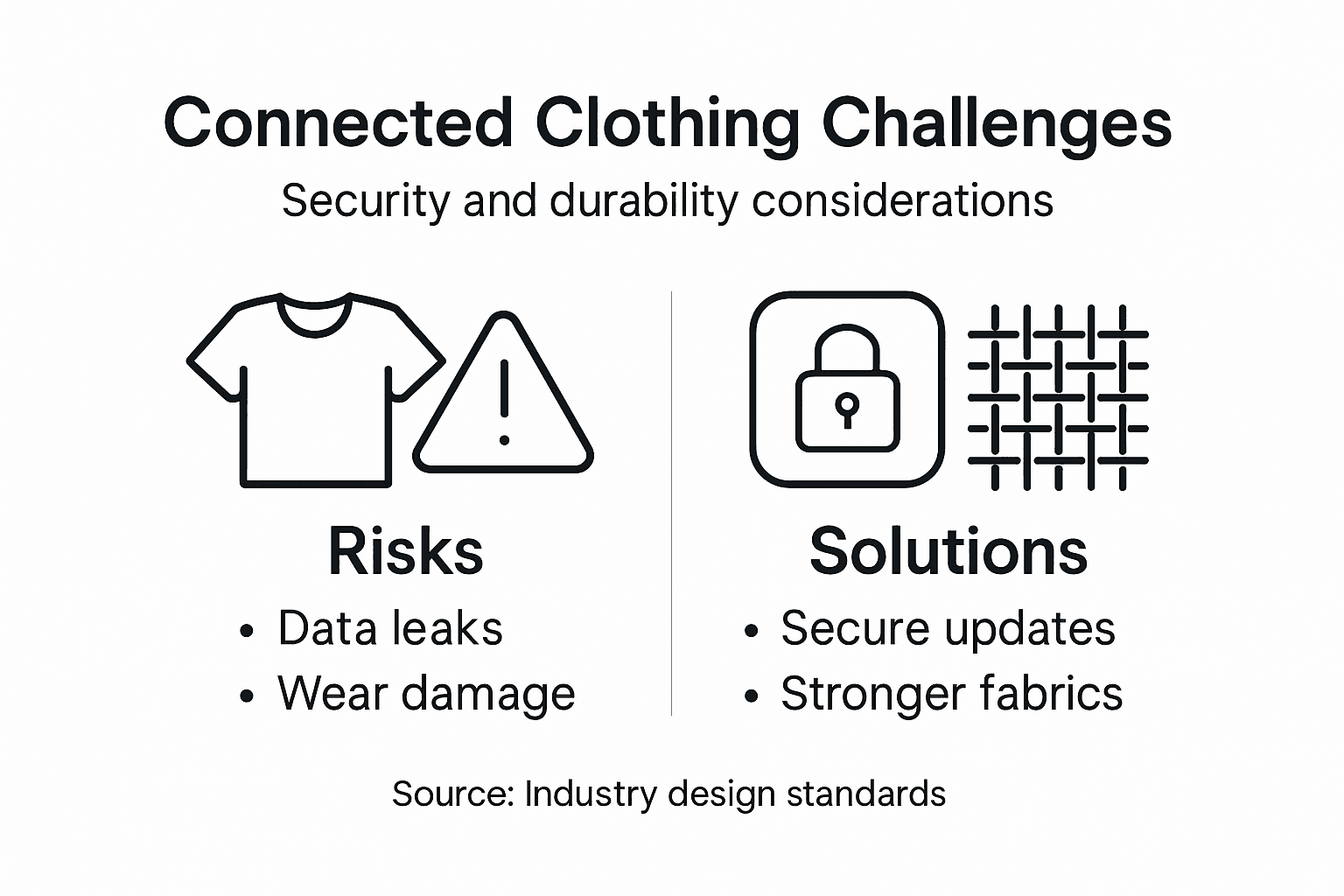
Continuous data collection in connected clothing introduces complex privacy challenges that demand sophisticated cybersecurity approaches. The seamless integration of sensors and communication technologies creates potential vulnerabilities that could expose sensitive personal information to unauthorized access.
Key privacy risks include:
- Data Interception: Potential unauthorized wireless signal monitoring
- Personal Information Exposure: Comprehensive health and location tracking
- Unauthorized Data Sharing: Potential third-party information selling
- Cybersecurity Vulnerabilities: Electronic system hacking risks
- Identity Tracking: Continuous personal behavior profiling
Durability challenges for connected clothing encompass multiple technical dimensions:
- Maintaining electronic component integrity during washing
- Ensuring sensor functionality under mechanical stress
- Preventing moisture and temperature damage
- Protecting flexible electronic circuits
- Sustaining performance through repeated use
Cybersecurity measures for smart textiles require multi-layered protection strategies that safeguard user data while maintaining technological functionality. Advanced encryption, secure communication protocols, and user-controlled privacy settings become critical in mitigating potential risks.
Privacy in connected clothing is not a feature, but a fundamental requirement.
Engineers and designers must balance technological innovation with robust security frameworks. This involves developing materials that can withstand environmental challenges while implementing sophisticated data protection mechanisms that give users complete control over their personal information.
Pro tip: Always review privacy settings and choose connected clothing brands that offer transparent data management and user-controlled privacy controls.
The following table summarizes privacy and durability strategies for connected clothing:
| Challenge | Effective Solution | Example Practice |
|---|---|---|
| Data Privacy | End-to-end encryption | Secure user data transmission |
| Unauthorized Access | Biometric authentication | Use of fingerprint or heart sensor login |
| Durability | Reinforced electronic fibers | Protected from frequent washing cycles |
| Component Longevity | Modular component design | Easy replacement and upgrades |
| Cybersecurity | Regular software updates | Patch vulnerabilities proactively |
Experience the Future of Security and Style with Connected Clothing
The article highlights the growing need for enhanced personal security through connected clothing that offers seamless health and environmental monitoring. If you are concerned about protecting your privacy, tracking your safety, and improving your daily life through smart apparel, InvisiTechWear has you covered. Our tech-infused collections combine style with advanced security features designed for modern challenges such as biometric authentication and real-time alerts. Discover the perfect blend of comfort and cutting-edge technology with our range of Hoodies and Jackets that elevate everyday protection.
Take control of your security today by exploring our innovative apparel and accessories at InvisiTechWear. Stay ahead with smart clothing that protects your privacy while enhancing your lifestyle. Shop now for immediate access to next-generation connected clothing that works as hard as you do.
Frequently Asked Questions
What is connected clothing?
Connected clothing refers to garments that integrate technology, such as sensors and electronics, enabling them to monitor health metrics, provide real-time data, and enhance security for the wearer.
How does connected clothing enhance personal security?
Connected clothing enhances personal security through features like emergency detection, location tracking, biometric authentication, and environmental hazard warnings, providing individuals with real-time information about their health and safety.
What are some practical applications of connected clothing in daily life?
Practical applications of connected clothing include monitoring vital signs for chronic disease management, optimizing fitness performance for athletes, providing workplace safety alerts, and helping individuals manage stress through real-time physiological tracking.
What privacy risks are associated with connected clothing?
Privacy risks include data interception, unauthorized sharing of personal information, and cybersecurity vulnerabilities. It’s important to choose garments that implement strong encryption and user-controlled privacy settings.


