

TL;DR:
- Conduct a thorough wardrobe audit to identify and remove unused or ill-fitting items.
- Define your lifestyle needs and create a curated, versatile wardrobe with quality pieces.
- Utilize technology and smart accessories to optimize outfit planning, saving time and boosting confidence.
You open your closet every morning, stare at a packed rail of clothes, and still feel like you have nothing to wear. Sound familiar? Most professionals aren’t short on clothing. They’re short on a system. Between outdated fits, impulse buys that never get worn, and zero tech support for daily outfit decisions, getting dressed becomes a daily drain on time and confidence. This guide walks you through a structured, step-by-step process to audit, rebuild, and future-proof your wardrobe using smart strategies and modern tools that actually work for busy, style-conscious professionals.
Table of Contents
- Audit your current wardrobe for a clean slate
- Define your lifestyle and set wardrobe goals
- Invest smart: Quality, fit, and long-term savings
- Tech-enabled wardrobe upgrades for smarter styling
- Mastering edge cases: Hybrid work, travel, and budgeting
- The real secret: Efficiency and confidence beat trends
- Upgrade smarter: Explore tech-forward accessories
- Frequently asked questions
Key Takeaways
| Point | Details |
|---|---|
| Declutter strategically | Keep only what you truly wear and love to streamline choices and reduce stress. |
| Define clear goals | Tailor your wardrobe to match your work environment and personal style for year-round ease. |
| Invest in quality | Focus on well-fitting, versatile pieces for significant long-term savings. |
| Leverage smart tech | Use AI and digital tools to manage your closet, save time, and enhance outfit planning. |
| Adapt for all scenarios | Prepare for remote work, travel, and budget realities with modular, camera-ready solutions. |
Audit your current wardrobe for a clean slate
Before you buy a single new piece, you need to know exactly what you’re working with. Pull every work-related item out of your closet and lay it flat. Yes, everything. This physical act alone forces honest evaluation in a way that a quick scroll through your rail never will.
For each item, ask three questions: How often do I actually wear this? Does it fit my body right now? Does it make me feel confident? If the answer to any of these is a hard no, the item goes. A McKinsey study found that people wear only 20% of their wardrobes regularly. That means roughly 80% of what’s hanging in your closet is dead weight.
Use this simple tracking table to sort items during your audit:
| Item | Worn in last 3 months | Fits well | Feels confident | Keep or Go |
|---|---|---|---|---|
| Navy blazer | Yes | Yes | Yes | Keep |
| Gray trousers | No | No | No | Go |
| White dress shirt | Yes | Yes | Yes | Keep |
| Striped tie | No | Yes | No | Go |
Once sorted, follow these steps to finalize your audit:
- Separate every item into three piles: keep, donate, and resell.
- Check each “keep” item for wear, damage, or outdated styling.
- Resell higher-value pieces through platforms like Poshmark or ThredUp.
- Donate the rest to a local shelter or clothing drive.
- Store seasonal items in labeled bins, not on your main rail.
Pro Tip: Use a free checklist app like Notion or Todoist to build a reusable audit checklist. Run it every six months so your closet never gets bloated again.
Aligning what stays with your current body and career stage matters more than most people realize. A suit that fit you three years ago in a different role sends a different message than one tailored to who you are now. Exploring minimalist fashion strategies can help you decide which pieces truly earn their place going forward.
Define your lifestyle and set wardrobe goals
With your closet cleared out, the next step is making sure every future purchase serves a real purpose in your life. This means getting specific about your work environment, your personal style, and the practical demands of your daily routine.
Start by mapping out your lifestyle. Consider these key factors:
- Work environment: Corporate office, creative agency, hybrid, or fully remote?
- Dress code: Formal, business casual, smart casual, or flexible?
- Climate and season: Do you face harsh winters, humid summers, or mild year-round weather?
- Social and travel demands: Do you attend client dinners, conferences, or frequent work trips?
- Personal style identity: Classic, modern minimalist, bold, or understated?
Being honest here saves you from buying pieces that look great on a mood board but never leave the hanger. A remote worker who occasionally visits the office needs a very different wardrobe than a client-facing consultant who travels weekly.
Once you’ve mapped your lifestyle, set a clear target for your wardrobe size. Experts recommend 25 to 40 pieces per season, excluding shoes and accessories, for versatile outfits without overthinking. That number sounds small until you realize how many combinations 35 well-chosen pieces can generate.

Pro Tip: Build a digital mood board using Pinterest or Canva. Pin outfits that reflect the professional you want to project, not just the clothes you currently own. This visual reference keeps your buying decisions focused and intentional.
Exploring convenience-focused fashion trends can also help you identify which functional features matter most for your specific lifestyle. And if you want a structured framework for the whole process, a tech-fashion wardrobe plan gives you a proven starting point.
Invest smart: Quality, fit, and long-term savings
Once your wardrobe’s scope is clear, the real work begins: spending wisely. Most professionals make the mistake of buying more instead of buying better. A wardrobe built on quality pieces that fit perfectly will always outperform a closet stuffed with cheap options that wear out fast.
The most effective structure follows a 70/20/10 split: 70% core pieces (neutral, versatile, season-spanning), 20% seasonal items, and 10% accent pieces that add personality. This ratio keeps your wardrobe functional without becoming boring.
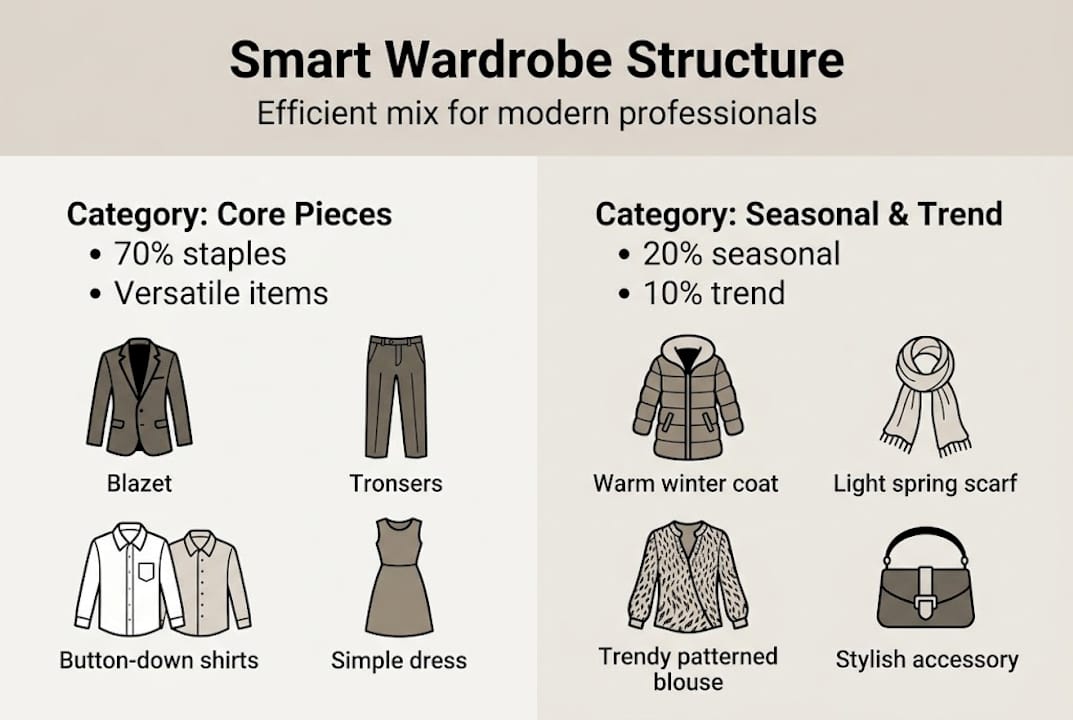
Here’s how a capsule investment compares to a fast fashion approach over time:
| Factor | Capsule wardrobe | Fast fashion wardrobe |
|---|---|---|
| Initial investment | Higher (approx. $3,600) | Lower |
| Lifespan per piece | 5 to 10 years | 1 to 2 years |
| Annual replacement cost | Low | High |
| Cost per wear | Very low | High |
| 5-year total spend | Significantly lower | Significantly higher |
A capsule investment of around $3,600 upfront can yield a 40% reduction in annual clothing costs over five years compared to fast fashion. That’s not just a style win. It’s a financial one.
Follow these steps to maximize quality and fit:
- Buy from brands with clear fabric and construction details.
- Try everything on before committing, even when shopping online.
- Budget for one or two tailoring sessions per year to keep fits sharp.
- Prioritize natural fabrics like wool, cotton, and linen for longevity.
- Avoid trend-driven pieces for your core 70%; save novelty for your accent 10%.
For a curated look at which items deliver the best return, check out the best smart clothing options built for professionals. Pairing quality garments with minimalist wardrobe tips keeps your system lean and high-performing.
Tech-enabled wardrobe upgrades for smarter styling
Having refined your wardrobe and spent wisely, technology can make your new setup seamlessly efficient and adaptable. AI-powered wardrobe apps are no longer novelty tools. They’re practical systems that analyze your wear patterns, flag closet gaps, and generate outfit suggestions based on your calendar, weather, and personal style.
Here are the top apps worth integrating:
- Alta: Builds a digital closet from photos and generates daily outfit suggestions synced with weather and schedule.
- Vêtir: Focuses on outfit generation and travel packing, helping you do more with fewer pieces.
- StylistIQ: Analyzes your style preferences and recommends purchases to fill actual gaps, not just add volume.
- Stylebook: Tracks cost-per-wear data and gives you a visual catalog of everything you own.
- Smart Closet: Offers outfit logging and seasonal analytics to show what you actually wear versus what collects dust.
Apps like Alta, Vêtir, and StylistIQ can save users 15 or more minutes per day and optimize both packing and outfit decisions. Over a year, that adds up to nearly 90 hours returned to your schedule.
“The professionals who look most put-together aren’t necessarily spending more time getting dressed. They’ve built smarter systems that make great decisions automatic.”
The broader shift happening here is what designers call the “phygital” wardrobe, where physical clothing and digital management tools work together as one system. Your clothes exist in the real world, but your planning, tracking, and optimization happen in an app. Exploring digital fashion for professionals shows how this trend is reshaping daily style routines. For a deeper look at building this kind of setup, the tech-infused fashion guide is a solid next read.
Mastering edge cases: Hybrid work, travel, and budgeting
With your wardrobe optimized and made smarter, the final challenge is staying sharp when circumstances get complicated. Hybrid schedules, frequent travel, and tight budgets each create unique pressures that even a well-built wardrobe can struggle to handle without the right strategies.
Here’s how to handle each scenario:
- Hybrid work: Prioritize camera-friendly layers. A clean, solid-color top with good contrast reads well on video calls and works just as well in person. Avoid busy patterns that distort on screen.
- Business travel: Build a modular travel capsule. One well-fitted suit paired with interchangeable layers can generate five or more distinct outfits for a week-long trip.
- Budget management: Spend 3 to 5% of your take-home pay annually on clothing. For a $60,000 salary, that’s roughly $1,800 to $3,000 per year, enough for quality upgrades without financial strain.
- Seasonal transitions: Invest in transitional pieces like lightweight wool blazers and layering knits that work across multiple seasons without needing a full wardrobe swap.
- Unexpected dress codes: Keep one formal option and one smart-casual option always clean and ready. These cover 90% of surprise events.
Pro Tip: When packing for business trips, photograph your planned outfits before you leave. This takes two minutes and eliminates the “did I pack enough?” anxiety that wastes mental energy on the road.
For more guidance on pulling tech and style together in real-world settings, modern wearable tech style offers practical outfit frameworks. And if you work in an urban environment, urban techwear tips can help you navigate city-specific style demands with confidence.
The real secret: Efficiency and confidence beat trends
Here’s something most style advice gets wrong: it tells you to add more variety. More colors, more silhouettes, more seasonal updates. But the professionals who consistently look sharp aren’t buying more. They’re choosing better and deciding faster.
Conventional wisdom pushes wardrobe variety as the solution to outfit fatigue. The real solution is efficiency in wardrobe management. When your closet is curated to match your actual life, and when tech tools handle the daily decision-making, getting dressed stops being a problem entirely.
Trends will always exist. But a trend-chasing wardrobe is an expensive, exhausting treadmill. A streamlined, personalized, tech-enabled wardrobe is a system that works for you every single day. The professionals who look most polished aren’t the ones following every runway update. They’re the ones who’ve built enough confidence in their own style that the trends become optional, not obligatory. That shift in mindset, backed by smart tools and intentional curation, is what separates a good wardrobe from a great one.
Upgrade smarter: Explore tech-forward accessories
You’ve done the hard work of auditing, goal-setting, and investing in quality clothing. Now it’s time to extend that same thinking to what you carry every day.
At InvisiTechWear, we design accessories that match the same standards you now hold your wardrobe to: functional, sleek, and built to last. Our minimalist RFID wallet combines carbon fiber construction with RFID-blocking technology, keeping your cards secure without adding bulk to your pocket. For those who carry more, our multi-functional slim wallet holds up to 12 cards in an ultra-thin profile that disappears into any outfit. A complete wardrobe upgrade deserves accessories that keep up.
Frequently asked questions
What is the 20% rule for wardrobe upgrades?
The 20% rule means keeping only the clothes you genuinely wear and love, which research shows is typically just 20% of what most people own. Applying it cuts clutter and makes every outfit decision faster and easier.
How many pieces should a modern professional wardrobe have?
Experts recommend 25 to 40 pieces per season, not counting shoes and accessories, for a versatile range of outfits without decision fatigue. That focused number encourages intentional buying over accumulation.
Are tech-enabled wardrobe apps worth it?
Yes. AI wardrobe apps like Alta and StylistIQ can cut daily outfit planning by 15 or more minutes and help you identify real gaps in your closet rather than guessing. Over time, they also track cost-per-wear data that makes future buying decisions sharper.
How much should you budget for wardrobe upgrades annually?
Aim for 3 to 5% of your take-home pay each year on clothing. This range keeps your wardrobe fresh and functional without creating financial pressure or encouraging impulse buying.
What’s better: a minimalist capsule or an essentials-heavy wardrobe?
A minimalist capsule wardrobe prioritizes maximum versatility from fewer pieces, typically 15 to 30 items, while essentials-based wardrobes offer more variety with 30 or more pieces. Both approaches work best when they prioritize fit, cost-per-wear, and alignment with your actual lifestyle over sheer volume.


