

TL;DR:
- RFID and NFC are related but serve different functions with distinct security features.
- NFC offers short-range, secure communication ideal for payments and data sharing; RFID covers broader uses.
- Combining RFID-blocking and NFC-capable accessories provides comprehensive personal security and convenience.
Most people assume RFID and NFC are just two names for the same thing. They’re not. While NFC does live inside the RFID family, treating them as identical can lead you to buy the wrong wallet, skip protection you actually need, or pay for features that don’t match how you live. The gap between these two technologies matters more than most accessory guides admit. Whether you’re tapping your phone to pay, carrying a contactless credit card, or shopping for a slim wallet that protects your data, understanding what each technology actually does puts you in control of both your security and your style.
Table of Contents
- What are RFID and NFC? Core concepts and how they work
- RFID vs NFC: A direct comparison of frequencies, range, and communication
- Security, encryption, and privacy: What you need to know
- Which is best for you? Real-world uses in accessories and daily life
- Why the RFID vs NFC debate misses the point: Our take
- Find stylish RFID and NFC accessories for ultimate security
- Frequently asked questions
Key Takeaways
| Point | Details |
|---|---|
| NFC is a type of RFID | NFC operates within the RFID family but is specialized for extreme short-range, secure transactions. |
| Choose tech for your needs | Consider both your daily activities and accessory compatibility to decide between RFID and NFC. |
| Security depends on setup | NFC usually delivers stronger security out-of-the-box, but RFID with blocking or encrypted systems is highly effective. |
| Style meets function | Today’s accessories combine tech with fashion, delivering RFID or NFC protection without sacrificing aesthetics. |
What are RFID and NFC? Core concepts and how they work
RFID stands for Radio Frequency Identification. It’s a broad technology that uses radio waves to transmit data between a tag and a reader, no physical contact required. You’ve encountered it in building access cards, retail inventory systems, and luggage tracking at airports. RFID operates across three frequency bands:
- Low frequency (LF): 125 to 134 kHz, short range, used in animal tracking and older access cards
- High frequency (HF): 13.56 MHz, medium range, used in library cards and some transit passes
- Ultra-high frequency (UHF): 860 to 960 MHz, range up to 10 to 20 meters, used in supply chains and retail
NFC, or Near Field Communication, is a specialized subset of RFID. It operates at 13.56 MHz with a maximum range of about 4 centimeters. That tight range is intentional. It forces physical proximity, which dramatically reduces the chance of unauthorized reads. NFC also does something standard RFID typically can’t: it supports peer-to-peer communication, meaning two NFC devices can exchange data with each other, not just tag to reader.
For everyday accessories, this distinction is critical. RFID is mainly one-way, with a reader pulling data from a passive tag. NFC can do that too, but it also supports card emulation (your phone acting like a contactless card) and peer-to-peer sharing. That’s why NFC powers Apple Pay, Google Pay, and smart business card exchanges.
You can learn more about the foundational mechanics in this RFID technology basics breakdown, which covers how passive tags work and why frequency matters for protection.
“NFC is not just a shorter-range RFID. It’s a smarter, more interactive protocol built for personal, secure exchanges where proximity itself is part of the security model.”
Pro Tip: If you want an accessory that supports digital wallet functions like Apple Pay passthrough or smart tag sharing, confirm it’s explicitly labeled “NFC-enabled.” RFID-blocking alone won’t provide that capability.
With foundational concepts in place, it’s time to see exactly how RFID and NFC stack up against each other.
RFID vs NFC: A direct comparison of frequencies, range, and communication
Here’s where the practical differences become impossible to ignore. The specs below aren’t just technical trivia. They directly shape what each technology can and can’t do in a wallet, phone case, or smart ring.
| Feature | NFC | RFID (LF/HF/UHF) |
|---|---|---|
| Frequency | 13.56 MHz (fixed) | 125 kHz / 13.56 MHz / 860-960 MHz |
| Range | Up to 4 cm | Up to 20 meters (UHF) |
| Communication | Two-way (peer-to-peer capable) | Mostly one-way |
| Security | Built-in encryption, proximity-based | Varies by system |
| Common uses | Payments, smart accessories, sharing | Inventory, access control, tracking |
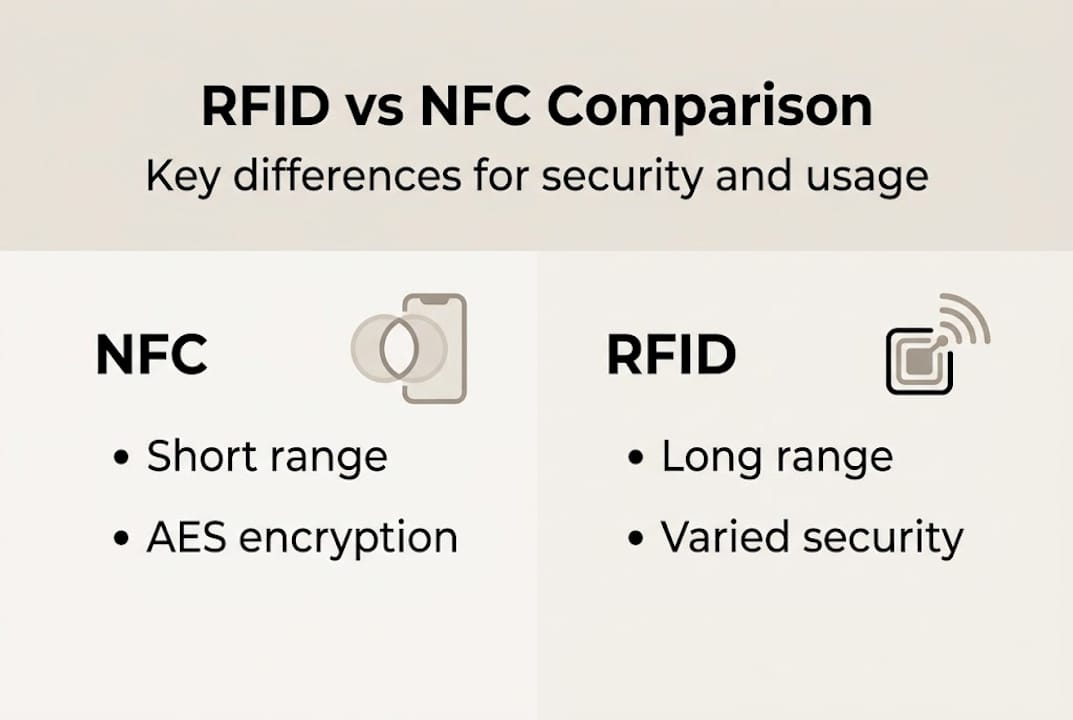
As confirmed by NFC frequency specs, NFC is fixed at 13.56 MHz while RFID spans from 125 kHz all the way to 960 MHz depending on the application. That range flexibility is RFID’s strength in logistics. It’s also the reason UHF RFID can be read from across a warehouse, which is great for supply chains and a potential privacy concern for personal cards.
NFC supports three distinct operating modes:
- Reader/writer mode: Your NFC device reads or writes to a passive NFC tag (like a smart label)
- Card emulation mode: Your device acts as a contactless card (this is how tap-to-pay works)
- Peer-to-peer mode: Two NFC devices exchange data directly
RFID, by contrast, is almost always one-directional. A reader queries a tag, the tag responds. There’s no back-and-forth negotiation, which limits interactivity but keeps the system simple and fast for high-volume scanning.
When it comes to privacy and style with RFID, the choice of frequency and range has real consequences for how exposed your cards are in public spaces.
“NFC is a subset of RFID, but its one-touch simplicity and security make it ideal for personal accessories.”
The checklist for choosing between them comes down to three questions: What range do you actually need? How high is your security priority? And is your accessory or device compatible with the tech you’re selecting?
Having compared how they connect and communicate, let’s explore how established standards ensure safety and reliability.
Security, encryption, and privacy: What you need to know
This is where the stakes get real. Both RFID and NFC can be secure, but they don’t start from the same baseline.

NFC has built-in AES encryption and mutual authentication baked into its standard. Combined with its 4 cm range, the attack surface is tiny. An eavesdropper would need to be essentially touching you to intercept a transaction. That’s why NFC is trusted for mobile payments globally.
RFID security is more variable. HF RFID systems can be encrypted and secure. But many passive UHF tags carry open data with no authentication at all. That’s fine for a box of cereal on a warehouse shelf. It’s a problem if those same principles apply to your access badge or loyalty card.
Here are the main privacy risks worth knowing:
- Skimming: A rogue reader silently pulls data from your RFID card without your knowledge
- Eavesdropping: Someone intercepts the signal between a legitimate reader and your card
- Relay attacks: Data is captured and replayed elsewhere to simulate your card’s presence
- Unauthorized access: Cloned credentials used to enter secured spaces
The good news: RFID-blocking against identity theft is a proven countermeasure. RFID-blocking materials create a Faraday cage around your cards, preventing any external reader from making contact. And the RFID security basics are straightforward to apply through the accessories you already carry.
RFID-blocking accessories can reduce identity theft incidents by up to 90%, making them one of the most cost-effective security upgrades available.
Pro Tip: If your wallet holds any contactless card, including credit cards, transit passes, or work badges, choose an RFID-blocking wallet. It costs almost nothing extra and eliminates a real, documented risk.
With a solid understanding of security, how do these technologies actually show up in products you might want, especially accessories that combine style with function?
Which is best for you? Real-world uses in accessories and daily life
The right technology depends entirely on what you’re carrying and what you need it to do. Here’s a practical breakdown by accessory type:
| Accessory | Best tech | Why |
|---|---|---|
| Credit card wallet | RFID-blocking | Protects passive cards from skimming |
| Phone case | NFC-capable | Enables tap-to-pay and smart tag reads |
| Smart ring | NFC | Peer-to-peer sharing, payments |
| Travel bag | RFID-blocking | Shields passports and hotel key cards |
| Multi-function wallet | Both | Blocks threats, enables NFC payments |
| Access badge holder | RFID-blocking | Prevents credential cloning |
As RFID and NFC are complementary, not competing technologies, the smartest accessories often incorporate both. A well-designed wallet can block unauthorized RFID reads while still letting you tap your phone for payments.
When deciding what to buy, consider these scenarios:
- Choose RFID-blocking if you carry contactless credit cards, a passport, or a work access badge
- Choose NFC-capable if you want to use your accessory for tap-to-pay, smart sharing, or app integration
- Choose both if you want maximum flexibility without sacrificing protection
Our guide to RFID-blocking style walks through how modern accessories handle both needs without looking like tech gear. And if you’re narrowing down options, this resource on choosing RFID-blocking accessories covers what specs to look for in 2026. For wallet-specific decisions, the breakdown on choosing RFID wallets is worth a read before you buy.
Beyond the specs, it’s important to consider which technology to choose for your unique needs and aesthetics.
Why the RFID vs NFC debate misses the point: Our take
Here’s what most tech guides won’t tell you: the “RFID vs NFC” framing is a false choice. Real-world use doesn’t ask you to pick a side. It asks you to match the right tool to the right situation.
We’ve seen people overpay for NFC-enabled accessories when all they needed was solid RFID blocking for their credit cards. We’ve also seen people skip NFC entirely and then wonder why their “smart” wallet doesn’t support tap-to-pay. Both mistakes come from treating this as a binary decision.
The smarter move is to think in layers. What cards are you protecting? What functions do you actually use? A minimalist who pays with their phone and carries two cards needs a different solution than someone managing multiple access badges and loyalty cards.
Style and security don’t have to compete. The best accessories handle both without you having to think about it. Check out our top RFID-blocking wallets to see how far the design has come. The goal isn’t to pick a technology winner. It’s to make intentional choices that fit how you actually live.
Find stylish RFID and NFC accessories for ultimate security
Ready to apply what you’ve learned and upgrade your accessory game? At InvisiTechWear, we’ve built our collection around exactly this intersection of protection and design. Whether you need pure RFID blocking, NFC functionality, or both, there’s a product here that fits your lifestyle without compromising your look.

Our slim RFID-blocking wallet is a standout for anyone who wants minimalist design with serious card protection built in. It’s engineered to block unauthorized reads while keeping your carry light and clean. Browse the full range at InvisiTechWear to find wallets, bags, and accessories that match both your security needs and your personal style.
Frequently asked questions
Is NFC always more secure than RFID for personal accessories?
NFC offers built-in encryption and short proximity, making it more secure in most personal accessory scenarios, while RFID security depends heavily on the system’s encryption and whether blocking features are present.
Can one product contain both RFID and NFC functionality?
Yes, many modern smart wallets and cases integrate both, with RFID-blocking material protecting your cards while NFC capability supports payments and smart tag interactions. RFID and NFC are complementary and are increasingly combined in well-designed accessories.
How do I check if my accessory is NFC-enabled?
Look for the word “NFC” or the contactless symbol on the product itself or in the manufacturer’s technical specifications. If neither appears, the accessory likely only offers passive RFID blocking.
Do I need RFID-blocking if I pay with my phone?
RFID-blocking protects the physical cards in your wallet, while NFC payments use encryption and require close physical proximity, so both protections serve different purposes and can coexist in the same carry setup.


