

Nearly 40 percent of American young professionals now carry contactless cards that leverage RFID technology, yet myths about security risks still circulate. As urban life moves faster and digital wallets become the norm, understanding how RFID works—and how to defend against data theft—becomes essential. This guide breaks down RFID fundamentals, clears up common misconceptions, and highlights how the right accessories bring style and peace of mind to your daily routine.
Table of Contents
- RFID Technology Defined and Common Misconceptions
- Types of RFID: Low, High, and UHF Explained
- How RFID Works in Everyday Products
- Risks of RFID: Security and Privacy Concerns
- Protecting Yourself with RFID-Blocking Accessories
Key Takeaways
| Point | Details |
|---|---|
| Understanding RFID | RFID technology enables automatic identification and tracking of objects without direct line of sight, offering robust applications across various industries. |
| Types of RFID | RFID operates at three main frequency ranges: Low Frequency, High Frequency, and Ultra-High Frequency, each suited for different uses and environments. |
| Security and Privacy | RFID systems are vulnerable to risks like unauthorized cloning and eavesdropping, necessitating the use of encryption and RFID-blocking accessories. |
| Proactive Protection | Investing in RFID-blocking accessories adds an extra layer of security and peace of mind, although they are not a complete security solution. |
RFID Technology Defined and Common Misconceptions
Radio Frequency Identification (RFID) is a sophisticated wireless tracking technology that uses electromagnetic fields to automatically identify and track objects. Unlike traditional barcode systems, RFID enables identification from a distance without requiring direct line of sight, making it a game-changing technology across multiple industries. Electromagnetic tracking principles allow these systems to function through radio wave communication between tags and readers.
RFID systems typically consist of three core components: tags, readers, and a transmitter. Tags are small electronic devices containing stored information that can be passive (powered by reader signals) or active (with their own battery power). Readers emit radio waves to communicate with tags, while transmitters help facilitate data exchange. These systems operate across varying distances, from a few centimeters to several meters, depending on the specific technology and tag type.
One significant misconception about RFID is that it represents an absolute security threat. While privacy concerns exist, modern RFID technologies have developed robust encryption and security protocols to protect sensitive information. Privacy standards in radio frequency identification have been continuously improving, addressing potential vulnerabilities and ensuring user data remains protected.
Pro tip: When selecting RFID-enabled products, always verify the security features and encryption standards to ensure maximum protection of your personal information.
Types of RFID: Low, High, and UHF Explained
RFID technologies are categorized by their frequency ranges, each offering unique capabilities and applications across different industries. RFID frequency classifications provide a comprehensive framework for understanding these technological variations. The three primary frequency types are Low Frequency (LF), High Frequency (HF), and Ultra-High Frequency (UHF), each with distinct characteristics that make them suitable for specific use cases.
Low Frequency (LF) RFID systems operate between 30 kHz and 300 kHz and are typically used in access control, animal tracking, and automotive immobilization. These tags have short read ranges typically around 10 centimeters and perform well in environments with metal or liquid interference. High Frequency (HF) tags, operating between 3 MHz and 30 MHz, offer improved performance and are commonly used in payment systems, library book tracking, and smart card technologies. They provide read ranges up to 1 meter and excel in data transfer scenarios.

Ultra-High Frequency (UHF) RFID represents the most advanced and versatile frequency range, operating between 300 MHz and 3 GHz. Advanced RFID technology classifications reveal that UHF tags can read over distances of 12 meters, making them ideal for supply chain management, inventory tracking, and logistics. These tags can be passive or active, with passive UHF tags drawing power directly from the reader’s electromagnetic field.
Pro tip: When selecting an RFID system, carefully consider the specific frequency range that best matches your environmental conditions and data transfer requirements.
Here’s a comparison of RFID frequency types, their ranges, and common applications:
| RFID Type | Frequency Range | Typical Read Range | Common Uses |
|---|---|---|---|
| Low Frequency (LF) | 30 kHz–300 kHz | Up to 10 cm | Animal IDs, car immobilizers |
| High Frequency (HF) | 3 MHz–30 MHz | Up to 1 meter | Payment cards, library tracking |
| Ultra-High Frequency (UHF) | 300 MHz–3 GHz | Up to 12 meters | Supply chains, inventory management |
How RFID Works in Everyday Products
RFID wireless communication protocols enable seamless tracking and identification across numerous everyday products. At its core, RFID technology operates through a simple yet sophisticated system of three primary components: tags, antennas, and readers. These tags are small electronic devices embedded in products ranging from retail clothing to access control systems, each containing a unique identifier that can be wirelessly transmitted and received.
In practical applications, RFID tags function like digital fingerprints for objects. When an RFID reader comes within range, it generates an electromagnetic field that powers passive tags, allowing them to transmit their stored information instantly. Radio signal identification methods make this possible without requiring direct line of sight, which distinguishes RFID from traditional barcode scanning. Common everyday products utilizing this technology include contactless payment cards, smartphone authentication systems, inventory tracking chips in retail clothing, and security access badges.
The versatility of RFID extends across multiple industries, with different tag types serving specific purposes. Passive tags are most common in consumer products, drawing power directly from the reader’s signal and ideal for short-range applications like payment systems and access control. Active tags, which contain their own power source, can transmit signals over greater distances and are frequently used in logistics, tracking shipping containers, and managing complex supply chain networks.
Pro tip: Always check your products for RFID tags and consider using protective wallets or sleeves to prevent unauthorized scanning of sensitive personal information.
Risks of RFID: Security and Privacy Concerns
Security vulnerabilities in RFID technology reveal significant privacy challenges that demand careful attention from consumers and organizations alike. The primary risks stem from the fundamental nature of RFID technology: wireless transmission of data without physical contact or direct visibility. This characteristic makes RFID tags vulnerable to unauthorized interception, tracking, and potential data manipulation by malicious actors who can access information using specialized electronic equipment.
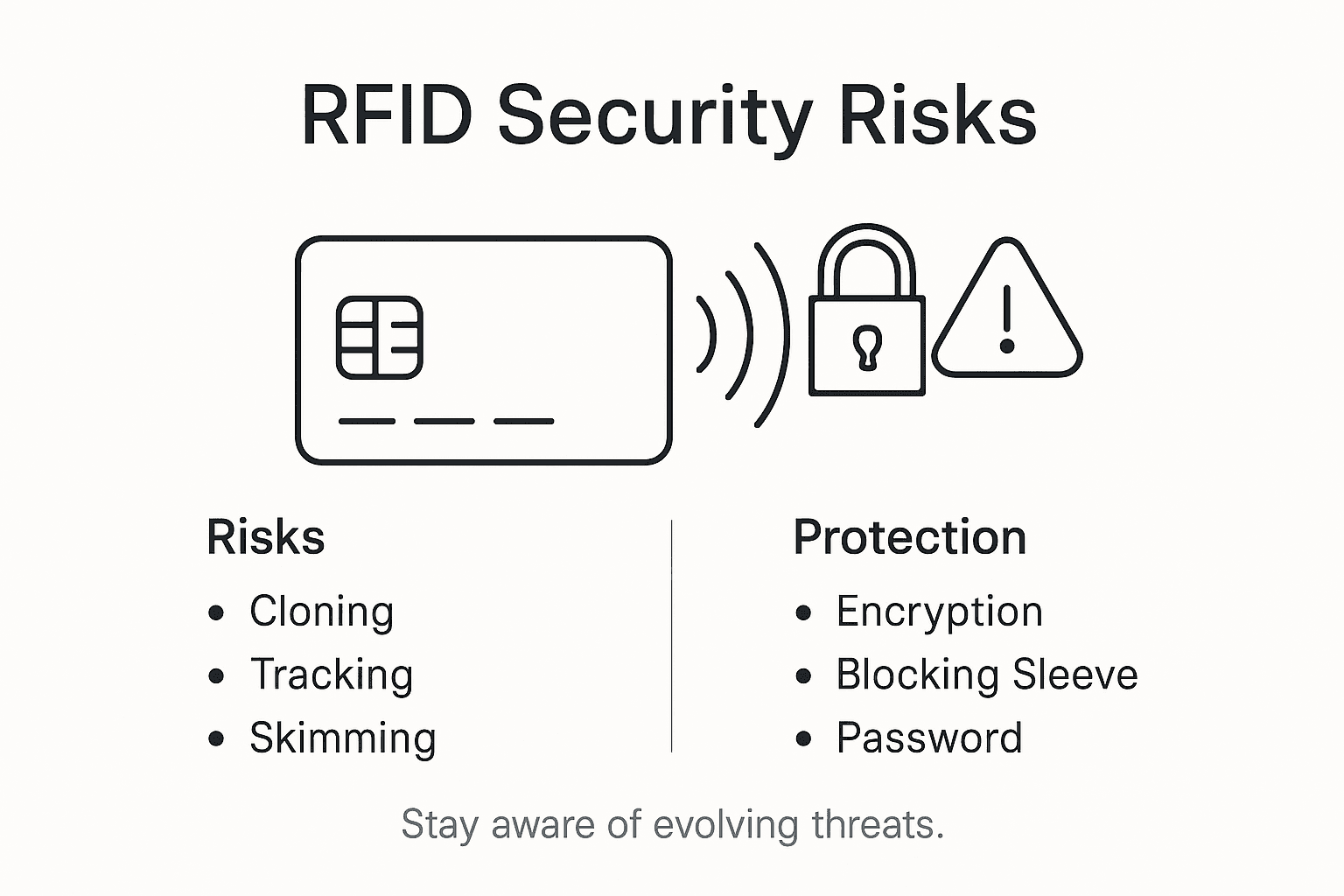
Unauthorized tag cloning represents one of the most serious security threats in RFID systems. Cybercriminals can potentially capture and replicate RFID signals, creating duplicate tags that mirror the original identification data. Public privacy concerns surrounding RFID technologies highlight the invisible nature of these systems, which can enable covert tracking and surveillance without an individual’s explicit consent. This raises profound questions about personal privacy, particularly in scenarios involving payment systems, access control, and personal identification documents.
The spectrum of RFID security risks extends beyond direct data theft. Advanced attackers can employ techniques like signal amplification, eavesdropping, and replay attacks to compromise RFID systems. These methods allow potential intrusion into secure environments, tracking personal movements, and accessing sensitive information stored on RFID-enabled devices. Organizations and technology developers continue to invest in advanced encryption, signal shielding, and authentication protocols to mitigate these emerging threats.
Pro tip: Invest in RFID-blocking accessories and regularly update your understanding of potential security risks to maintain personal data protection.
This table summarizes key risks of RFID and strategies to reduce them:
| Risk Type | Example Scenario | Prevention Method |
|---|---|---|
| Cloning | Duplicate access cards created | Enable encryption, two-factor ID |
| Eavesdropping | Data read by hidden scanners | Use RFID-blocking wallets |
| Replay Attacks | Reuse of intercepted ID data | Rolling code protocols |
| Tracking | Personal movement monitoring | Selectively disable RFID tags |
Protecting Yourself with RFID-Blocking Accessories
RFID blocking technologies represent a proactive approach to personal data security in our increasingly connected digital world. These specialized accessories use conductive materials strategically designed to create an electromagnetic shield that prevents unauthorized radio frequency signals from accessing sensitive information stored in credit cards, passports, and other RFID-enabled documents. While the actual risk of data theft remains relatively low, these accessories provide an additional layer of protection and peace of mind for tech-savvy consumers.
RFID-blocking accessories come in various forms, including wallets, passport holders, credit card sleeves, and even specialized clothing with integrated shielding. The core technology involves creating a barrier that interrupts electromagnetic waves, effectively creating a protective zone around your personal identification and payment cards. Most blocking materials utilize metallic fabrics or specialized synthetic compounds that can block radio frequencies across different spectrums, ensuring comprehensive protection against potential digital intrusions.
Consumers should understand that while RFID-blocking accessories offer protection, they are not an absolute guarantee of security. Modern RFID cards already incorporate advanced encryption technologies that make unauthorized data extraction extremely difficult. However, these accessories serve an important psychological function, providing users with a tangible sense of control over their personal digital security. The market offers a wide range of stylish and functional options, from minimalist card sleeves to sophisticated leather wallets that blend security with sophisticated design.
Pro tip: Invest in multi-functional RFID-blocking accessories that not only protect your data but also complement your personal style and daily tech needs.
Protect Your Personal Data with Style and Confidence
The detailed look into RFID technology reveals clear risks like unauthorized tracking and data theft that impact everyday security. If you want to protect your personal information from cloning, eavesdropping, or replay attacks you need reliable solutions that combine safety with style. Understanding terms like passive tags and encryption is only half the battle. Taking action to shield your RFID-enabled cards and documents is the key to peace of mind.
Discover how our range of RFID-blocking wallets & bags – Daon Tech offers a cutting-edge defense against wireless data theft.

Shop now at InvisiTechWear and upgrade your everyday accessories with smart protection that fits your lifestyle. Don’t leave your security to chance take control today with innovative designs crafted for maximum RFID-blocking performance and modern elegance.
Frequently Asked Questions
What is RFID technology and how does it work?
RFID (Radio Frequency Identification) technology uses electromagnetic fields to automatically identify and track objects through communication between tags, readers, and transmitters. It operates without needing direct line of sight, allowing for efficient identification of items from a distance.
What are the different types of RFID tags?
RFID tags are primarily classified into three types based on frequency: Low Frequency (LF), High Frequency (HF), and Ultra-High Frequency (UHF). LF tags work well in environments with interference but have short read ranges, HF tags are common in payment systems and have moderate ranges, while UHF tags can cover longer distances and are ideal for logistics and inventory management.
How can I protect my personal information stored on RFID tags?
You can protect your personal information by using RFID-blocking accessories like wallets and sleeves that create an electromagnetic shield against unauthorized scanning. It’s also wise to regularly update your knowledge of potential RFID security risks and choose products with encryption features.
What are the common risks associated with RFID technology?
Common risks include unauthorized tag cloning, eavesdropping, replay attacks, and tracking. These threats can compromise personal privacy and data security, making it essential to implement prevention measures such as encryption and using RFID-blocking products.


