

TL;DR:
- Wireless charging clothing embeds inductive coils into fabrics for cable-free power transfer.
- Current prototypes face challenges with wash durability, coil alignment, and efficiency.
- Future innovations aim for better materials, safety, and powering low-energy wearable electronics seamlessly.
Wireless charging no longer lives only on a nightstand pad. Right now, researchers and textile engineers are weaving inductive coils directly into the fabric of jackets, shirts, and hoovering somewhere between lab prototype and your next wardrobe upgrade. The idea that your hoodie could power your earbuds or health tracker without a single cable sounds far-fetched, but the physics behind it is real and advancing fast. This guide breaks down exactly what wireless charging clothing is, how it works at a technical level, where it succeeds and struggles, and what the next wave of innovation looks like for anyone serious about tech-forward style.
Table of Contents
- What is wireless charging clothing?
- How does wireless charging clothing work?
- Strengths, limitations, and real-world applications
- Future trends and what to look for in wireless charging clothing
- Why wireless charging clothing matters—and what most discussions miss
- Explore innovative wearables for a smarter lifestyle
- Frequently asked questions
Key Takeaways
| Point | Details |
|---|---|
| Embedded power in clothing | Wireless charging clothing integrates textile-based coils to deliver power to devices seamlessly while you wear them. |
| How it works | These garments use inductive coupling or alternative energy-harvesting textiles to wirelessly transfer power over short distances. |
| Strengths and drawbacks | Wireless charging clothing offers sleek integration but still faces efficiency losses, wash durability challenges, and limited commercial availability. |
| Trends and buying tips | Look for durable designs and emerging battery-free features as wireless charging clothing evolves from lab to lifestyle. |
What is wireless charging clothing?
Wireless charging clothing is exactly what it sounds like: garments with embedded electronics that can transfer power to devices without a cable. Instead of plugging in, the fabric itself becomes the charging surface. Wireless charging clothing integrates receiver coils or textile-based inductive systems directly into the garment structure, allowing energy to flow from a power source to a wearable device through the material.
The technology traces its roots to the Qi standard (pronounced “chee”), the same wireless charging protocol used in most modern smartphones. Qi relies on inductive coupling, where an alternating magnetic field generated by a transmitter coil induces a current in a nearby receiver coil. Engineers have adapted this principle to work with flexible, washable, and wearable materials instead of rigid plastic housings.
The core components of a wireless charging garment include:
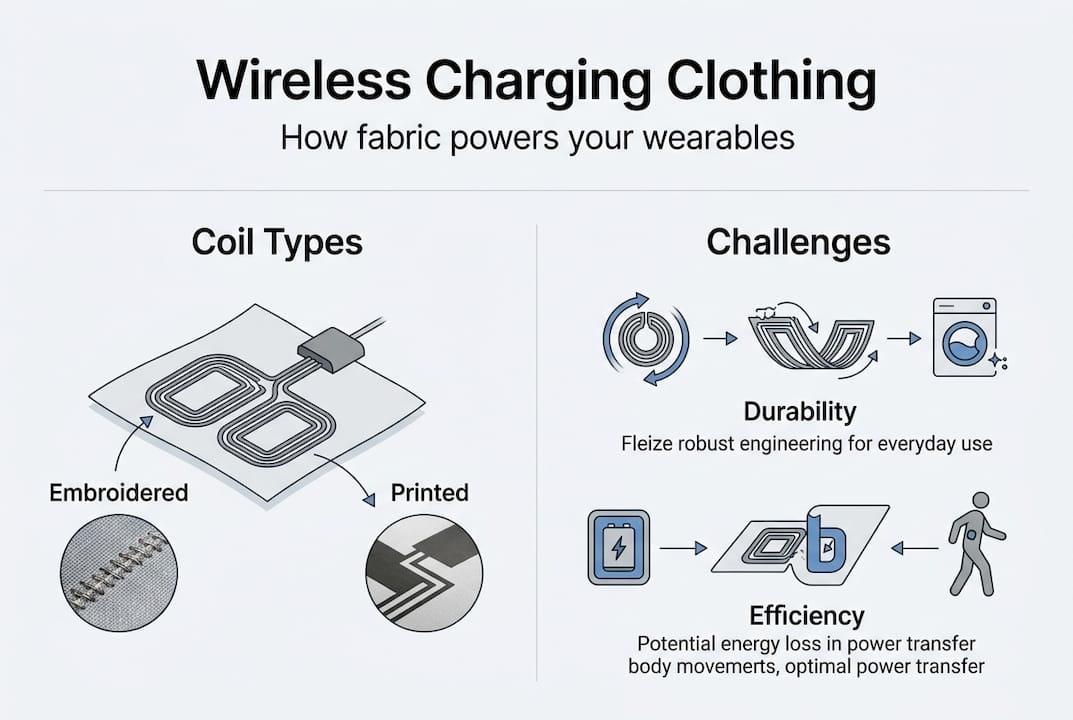
- Textile-based coils: Conductive threads or printed circuits woven or embroidered into the fabric
- Mini power units: Small, flexible battery packs or direct power inputs that act as the transmitter
- Receiver electronics: Thin, flexible circuit boards attached to wearables or embedded sensors that capture the transferred energy
- Rectifier circuits: Components that convert the alternating current from induction into usable direct current for devices
“The goal is not to replace your phone charger. The goal is to make small, body-worn electronics like fitness trackers, smart patches, and biosensors work continuously without ever needing to be removed and plugged in.”
This is a meaningful distinction. Wireless charging clothing is not designed to fast-charge your smartphone from your sleeve. It targets the growing ecosystem of types of smart clothing that includes health monitors, LED displays, haptic feedback systems, and environmental sensors. These devices consume far less power than a phone, making textile-based energy transfer a realistic solution. Understanding the smart clothing features these garments support helps clarify why continuous, cable-free power delivery is such a compelling engineering target.
How does wireless charging clothing work?
The mechanism behind wireless charging clothing follows the same electromagnetic principles as a standard Qi pad, but the engineering challenges multiply significantly when your charging surface needs to flex, breathe, and survive a washing machine.
Inductive coupling with textile coils tuned to Qi standards forms the primary methodology, and here is how the process unfolds step by step:
- Power input: A flexible battery pack or wired power source feeds alternating current into a transmitter coil embedded in the garment
- Magnetic field generation: The transmitter coil produces an oscillating magnetic field around the fabric surface
- Energy capture: A receiver coil in a wearable device or embedded sensor sits within that magnetic field and has a current induced in it
- Rectification: The induced alternating current passes through a rectifier circuit, converting it to direct current
- Device charging: The direct current charges the device battery or powers the electronics directly
The coils themselves can be fabricated three ways: embroidery with conductive thread, screen printing with conductive ink, or laser-cut metal foil laminated onto fabric. Each method has trade-offs.
| Fabrication method | Flexibility | Wash resistance | Efficiency |
|---|---|---|---|
| Embroidered thread | High | Moderate | Lower |
| Screen-printed ink | Moderate | Lower | Moderate |
| Laser-cut foil | Lower | Higher | Higher |
Textile coil resistance data shows that higher resistance in fabric-based conductors directly reduces the quality factor of the coil, which limits how efficiently energy transfers across the gap. Thicker conductive threads improve efficiency but reduce comfort and drape.

Alignment is another critical variable. Standard Qi pads use magnets or physical guides to keep coils aligned. In clothing, body movement constantly shifts the relative position of transmitter and receiver, which drops transfer efficiency sharply when coils fall out of alignment.
Pro Tip: If you are evaluating early wireless charging garments, look for products that specify coil overlap tolerance. A system that maintains reasonable efficiency with 5 to 10 millimeters of misalignment is far more practical for real-world wear than one requiring perfect centering.
For more context on how these systems fit into the broader category of wireless charging in clothing and to see examples of wearable tech that already use embedded electronics, those resources provide useful grounding.
Strengths, limitations, and real-world applications
Wireless charging clothing sits at a genuinely exciting intersection of fashion and engineering, but honest evaluation requires looking at both sides.
Where it excels:
- Seamless integration means no visible ports, cables, or charging cradles
- Enables truly continuous operation for low-power biosensors and health monitors
- Opens the door to battery-free wearables that harvest energy from body movement or heat
- Keeps the aesthetic of the garment clean and uninterrupted
Challenges including coil resistance, misalignment, and washing durability remain the primary barriers to mainstream adoption. The body itself introduces complications too. Human tissue is dielectric, meaning it absorbs and scatters electromagnetic fields, which reduces the effective range and efficiency of near-field charging systems worn directly against skin.
| Feature | Traditional cable charging | Textile wireless charging | Rigid wireless pad |
|---|---|---|---|
| Portability | Low | High | Low |
| Efficiency | Very high | Moderate | High |
| Comfort | Low | High | N/A |
| Wash durability | N/A | Currently limited | N/A |
| Device compatibility | Universal | Limited | Qi-compatible |
The PolaTex e-textile system, a research prototype that uses body dielectric polarization to recover energy, demonstrated recovery of 10.2 milliwatts from body movement. That is enough to power a small biosensor or LED indicator continuously, but nowhere near enough for a smartphone or smartwatch with a large display.
Most wireless charging clothing today exists as research prototypes rather than retail products. A handful of academic and corporate labs have demonstrated working garments, but none have reached mass production. This is important context for anyone reading marketing materials that suggest the technology is already here at scale.
For those interested in maintaining smart clothing or weighing the smart clothing pros and cons more broadly, the wash durability issue is one of the most practical concerns to understand before investing in any e-textile product.
Future trends and what to look for in wireless charging clothing
The trajectory of wireless charging clothing points toward solving the durability and efficiency problems that currently limit real-world use. Several directions look particularly promising.
Meandered and zigzag coil geometries represent a significant advance because they conform better to body contours, reduce electromagnetic field exposure to tissue, and maintain more consistent alignment during movement. These designs are still primarily in research, but they signal where the engineering is heading.
What to watch for as the market develops:
- Washable conductive materials: New silver-coated and carbon-fiber threads that maintain conductivity after 50 or more wash cycles
- Hybrid energy harvesting: Garments that combine wireless charging with thermoelectric generators (which convert body heat to electricity) for redundant power sources
- Standardized receiver modules: Thin, detachable receiver patches that snap onto any garment, making the technology garment-agnostic
- Body-area network integration: Clothing that acts as a power backbone for multiple small devices worn simultaneously
- Improved power delivery: Research targets suggest watt-class delivery over larger fabric areas, which would support more capable devices
Pro Tip: When shopping for early-stage wireless charging fashion, prioritize products that disclose their coil fabrication method, wash rating, and device compatibility list. Vague claims about “wireless power” without those specifics usually indicate marketing language rather than functional technology.
Safety is also a growing focus. Body-worn electromagnetic systems must comply with specific absorption rate (SAR) limits, which measure how much electromagnetic energy human tissue absorbs. Zigzag and meandered coil designs help keep fields at the surface rather than penetrating tissue, which is a meaningful safety improvement over earlier flat spiral designs.
Exploring tech fashion innovations and comparing best tech-infused clothing options gives you a clearer picture of where the retail market currently stands relative to what research labs are demonstrating.
Why wireless charging clothing matters—and what most discussions miss
Most coverage of wireless charging clothing focuses on the novelty. The hoodie that charges your phone. The jacket with a hidden battery. These framings miss the deeper shift happening beneath the surface.
The real significance is not convenience charging. It is the possibility of making wearable electronics invisible in the truest sense. Right now, every fitness tracker, smart patch, and biosensor is constrained by its battery size. Make the garment the power source and suddenly the device can shrink to the size of a postage stamp, sit flush against skin, and never need removal.
What rarely gets discussed is how demanding that vision actually is. Fashion has strict requirements around weight, drape, texture, and washability. Energy systems have strict requirements around efficiency, safety, and reliability. Satisfying both simultaneously is genuinely hard, and most prototype garments compromise heavily on the fashion side to make the technology work.
We think the brands that will win in this space are the ones treating smart fabric as a material science challenge first and a marketing opportunity second. Demand real specifications. Ask about wash cycles, power output, and device compatibility before you buy into the hype.
Explore innovative wearables for a smarter lifestyle
Wireless charging clothing is still finding its footing, but the broader world of tech-integrated fashion is already delivering real value right now. At InvisiTechWear, we curate wearables and accessories built around the same principle: technology that disappears into your style rather than competing with it.

While wireless power in textiles matures, smart security innovations like our RFID-blocking wallet show exactly how functional technology can live inside everyday carry without adding bulk or compromising aesthetics. Browse our full range of RFID-blocking accessories and tech-infused apparel to find pieces that bring genuine innovation to your wardrobe today, not just in the future.
Frequently asked questions
Is wireless charging clothing available to buy today?
Most wireless charging clothing remains experimental, with no major commercial products widely available, though some smart garments using body energy harvesting are beginning to appear in limited releases.
Does wireless charging clothing pose any health or safety risks?
Meandered and zigzag coils confine electromagnetic fields to the body surface rather than penetrating tissue, making these systems generally safe for body contact at the power levels currently used.
How much power do textile-based wireless charging clothes deliver?
Textile coils achieve watt-class charging over body-scale areas, while body dielectric energy recovery systems like PolaTex recover around 10.2 milliwatts, enough for small biosensors but not for smartphones.
Are these garments washable and durable?
Textile degradation over wash cycles is one of the biggest durability challenges, so most current wireless charging garments require careful handling and have limited wash ratings compared to standard clothing.


