

TL;DR:
- 67% of wearables have critical security vulnerabilities exposing personal and health data.
- Wearable security includes data encryption, firmware updates, and biometric authentication.
- Choose stylish devices from trusted brands with transparent security practices and regular updates.
Most people assume their smartwatch or fitness tracker is just a fashion accessory with a few clever features. That assumption is expensive. 67% of wearables carry critical vulnerabilities, meaning the device on your wrist right now could be leaking your location, health data, or payment credentials to anyone within Bluetooth range. Wearable security is not a niche concern for IT professionals. It is a practical issue for anyone who values their privacy and their look. This guide walks you through what wearable security actually means, the real risks you face, the technologies protecting you, and how to shop smarter for accessories that deliver on both style and safety.
Table of Contents
- What is wearable security?
- Core security risks and threats
- Best practices and technologies for securing wearables
- How to choose stylish and secure wearables
- The uncomfortable truth about stylish wearables and real-world security
- Upgrade your security and style with innovative accessories
- Frequently asked questions
Key Takeaways
| Point | Details |
|---|---|
| Definition matters | Wearable security means protecting stylish, body-worn tech devices from data and privacy threats. |
| Risks are real | Common wearables face vulnerabilities in pairing, patches, and privacy, with 67% at high risk. |
| Best practices help | Strong encryption, biometric authentication, and regular OTA updates are essential for security. |
| Choose smart | Trust devices and brands with transparent policies, frequent updates, and compliance with leading standards. |
What is wearable security?
Wearable security is broader than most people realize. Wearable security refers to the full set of controls, policies, and standards applied to body-worn computing devices to protect the data they collect, transmit, and store. That covers smartwatches, fitness bands, smart rings, hearables, and increasingly, tech-infused clothing and accessories.
These devices sit at a unique intersection of fashion and function. You wear them all day. They know your heart rate, your sleep patterns, your location, and sometimes your financial accounts. Unlike a laptop you close and lock, a wearable is always on, always connected, and almost always paired to your smartphone.
The core security concerns break down into three areas:
- Personal data exposure: Wearables continuously collect biometric and behavioral data that can be intercepted or misused.
- Location tracking: GPS and Bluetooth signals can reveal your daily routines to bad actors.
- Health information leakage: Medical-adjacent data is highly valuable on the dark web and is often transmitted without adequate encryption.
What makes wearables uniquely challenging from a security standpoint is the tension between design and defense. Manufacturers prioritize slim profiles, long battery life, and seamless connectivity. Robust security features consume power and add complexity. The result is that security often gets compressed into whatever space is left after the design team finishes.
“The most dangerous assumption in wearable tech is that a beautiful device is a trustworthy one. Security is invisible by design, which means its absence is equally invisible.”
If you want to master wearable tech without compromising your privacy, the first step is understanding exactly what you are dealing with. Style and security are not opposites, but they require deliberate choices from both manufacturers and users.
Core security risks and threats
Bluetooth Low Energy, or BLE, is the wireless protocol that connects most wearables to your phone. It is efficient and convenient, but it comes with serious weaknesses. BLE vulnerabilities enable proximity attacks, replay attacks, and man-in-the-middle (MitM) interceptions, where an attacker silently captures data passing between your device and your phone. Many budget wearables still allow pairing without a PIN, meaning anyone nearby can connect.
Supply chain vulnerabilities add another layer of risk. CVE-2024-12248, a real documented flaw, demonstrated how firmware shipped directly from manufacturers can contain exploitable backdoors before the device even reaches your hands. You buy something new and it is already compromised.
| Threat Type | Risk Level | Common Devices Affected |
|---|---|---|
| BLE MitM attacks | High | Smartwatches, fitness bands |
| Unpatched firmware | Critical | Budget wearables, older models |
| Supply chain exploits | High | Devices from unaudited manufacturers |
| Privacy transparency gaps | Medium-High | Most consumer wearables |
Patch delays are a persistent problem. Unlike your smartphone, which gets regular security updates, many wearables go months or years without a firmware patch. By the time a vulnerability is publicly disclosed, millions of devices are still running the vulnerable version.
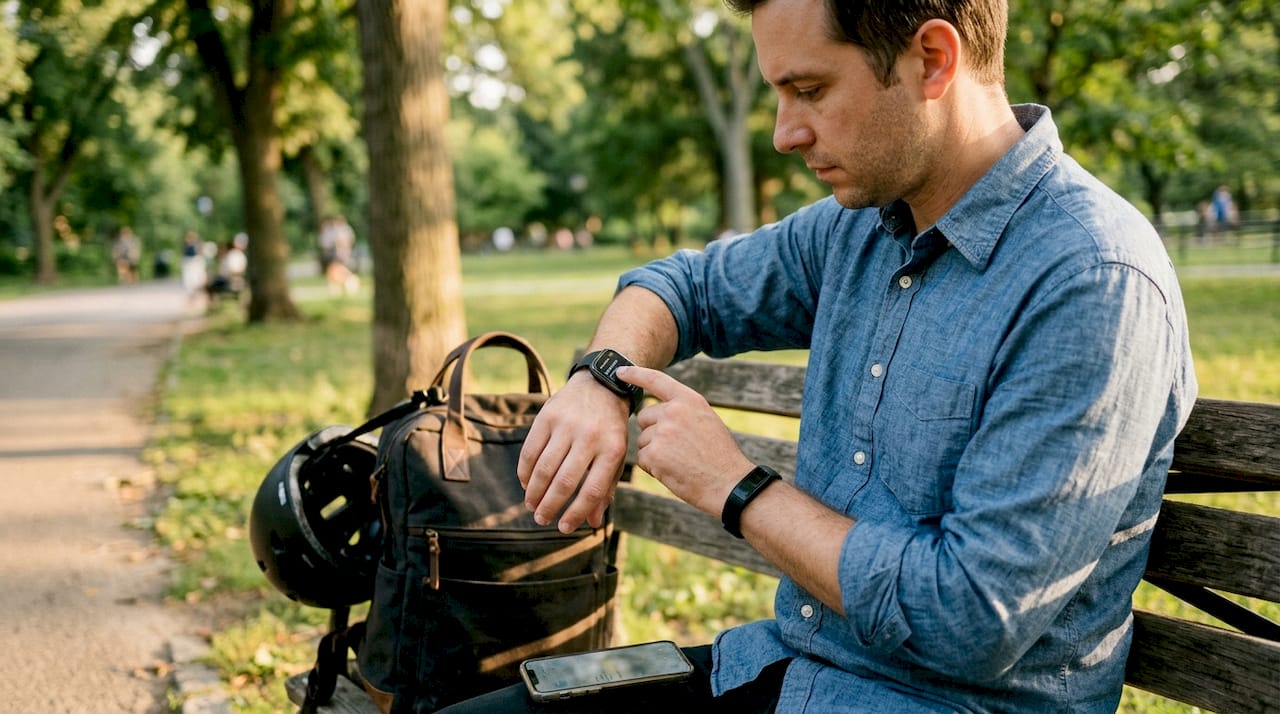
Privacy transparency is arguably the most overlooked risk. 76% of wearables score high risk in privacy audits due to poor transparency around data collection and breach disclosure. Most users have no idea what data is being shared, with whom, or for how long it is retained.
Pro Tip: Before buying any wearable, search the manufacturer’s name alongside “CVE” or “security advisory” to see if they have a track record of disclosing and patching vulnerabilities. Silence is not a good sign. Also check their privacy policy for explicit data retention limits and third-party sharing clauses.
For a deeper look at how anti-theft fashion principles apply to everyday accessories, the same scrutiny you apply to wearables should extend to everything you carry.
Best practices and technologies for securing wearables
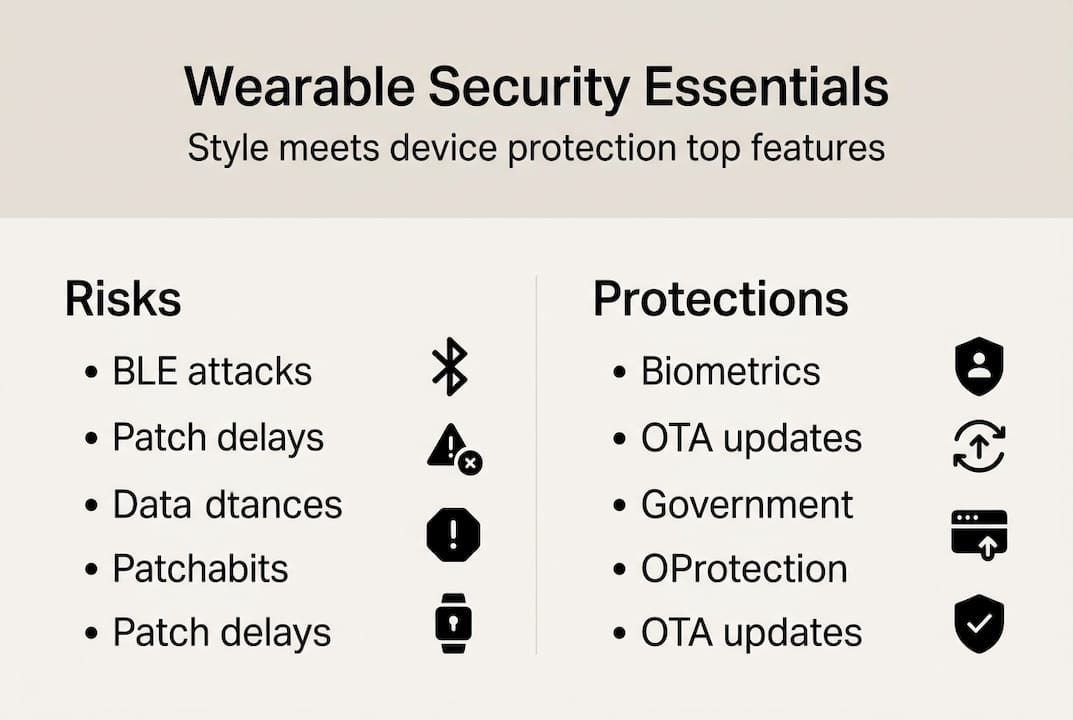
The good news is that the security technology for wearables has advanced significantly. Key mechanisms include BLE security layers, end-to-end encryption, over-the-air (OTA) firmware updates, and continuous biometric authentication with accuracy rates reaching up to 94.89%. These are not theoretical features. They exist in devices you can buy today.
Biometric authentication has moved well beyond simple fingerprint scans. Multi-biometric fusion combines gait analysis, heart rate patterns, and skin conductance to continuously verify your identity throughout the day. If someone steals your device and puts it on, the authentication system detects the behavioral mismatch and locks them out. No PIN required.
OTA updates are critical. A device that can receive security patches wirelessly without requiring a trip to a service center is dramatically safer than one that cannot. Always verify that a device supports OTA updates before purchasing.
Regulatory standards are also tightening. FDA guidelines require a Secure Product Development Framework, ongoing risk assessments, and post-market security updates for medical-grade wearables. NIST provides IoT cybersecurity guidance covering risk assessment, secure design principles, and baseline security requirements for connected devices.
| Standard | Scope | Key Requirement |
|---|---|---|
| FDA Cybersecurity Framework | Medical wearables | Secure development, post-market updates |
| NIST IR 8259 | All IoT devices | Risk assessment, secure baseline design |
| PSTI Act (UK-origin, global impact) | Consumer IoT | No default passwords, vulnerability disclosure |
Here is a practical checklist for evaluating your current or next device:
- Confirm the device supports OTA firmware updates.
- Verify end-to-end encryption is used for data transmission.
- Check that BLE pairing requires a PIN or passkey.
- Review the manufacturer’s history of security disclosures and patch timelines.
- Read the privacy policy for data retention and third-party sharing terms.
- Look for compliance with NIST or FDA guidelines if the device collects health data.
Pro Tip: Ask the retailer or check the manufacturer’s website for a security white paper. Brands that take security seriously publish one. Those that don’t often have something to hide.
For a full breakdown of what to look for, the security features guide covers the essentials, and the must-have secure gadgets list is a solid starting point for your next purchase.
How to choose stylish and secure wearables
Not all wearables are created equal, and the gap between the best and worst is significant. Apple, Samsung, and Google use strong encryption and consistent update cycles, while some Xiaomi and Huawei devices carry higher privacy risks due to less transparent data practices. That does not mean you have to sacrifice style for safety. It means you need to shop with intention.
For urban professionals who want both aesthetics and protection, prioritize FDA-compliant wearables like the Apple Watch, devices with edge AI processing (which keeps data on the device rather than in the cloud), OTA update support, and minimal cloud dependency. Edge AI is a genuine game-changer because it means your health and behavioral data never leaves your wrist.
Polar is another brand worth noting for fitness-focused users. Their devices have a strong reputation for transparent privacy practices and regular firmware updates, even if they lack the flashy marketing of bigger names.
Here are the key questions to ask before any wearable purchase:
- Does this device process data locally or send it to the cloud by default?
- When was the last firmware update released, and how frequently do updates occur?
- Does the manufacturer publish a privacy policy with explicit data retention limits?
- Is BLE pairing protected by a PIN or passkey?
- Has this device or manufacturer been associated with any unpatched CVEs in the past 24 months?
- Does the design support the security features, or do slim aesthetics compromise them?
Use the RFID security checklist to extend this thinking to your broader accessory setup, and browse wearable tech examples that prove security and style genuinely coexist.
The uncomfortable truth about stylish wearables and real-world security
Here is what most wearable reviews will not tell you: the security section is almost always an afterthought. Reviewers spend 90% of their time on display quality, battery life, and app integration. Security gets a paragraph, maybe two, and usually just repeats whatever the manufacturer claims.
The reality is that even major brands have shipped devices with unpatched BLE vulnerabilities that lingered for months. Continuous authentication enables seamless security experiences, but BLE remains a persistent weak point that demands strong pairing protocols to be effective. That nuance never makes it into the lifestyle press.
What do truly vigilant urban users actually do? They scrutinize update histories before buying, not after. They sacrifice one flashy feature in favor of a device with a documented security audit. They read privacy policies the way they read contracts, because that is exactly what they are.
Edge AI and seamless multi-biometric fusion represent the most promising path forward. When implemented well, they eliminate the tradeoff between convenience and security entirely. But implementation is the key phrase. The technology exists. Consistent, honest deployment across the industry does not yet.
The benefits of investing in wearable tech are real and growing. But they only materialize when you hold manufacturers accountable and make security a non-negotiable part of your buying criteria.
Upgrade your security and style with innovative accessories
Your wearable security strategy should not stop at your smartwatch. Every item you carry is part of your personal security ecosystem. If you are rethinking how you protect your data on your wrist, it makes sense to apply the same standard to your wallet.
The RFID blocking wallet from InvisiTechWear is built for exactly this mindset. It combines a slim, minimalist design with active RFID shielding that blocks unauthorized card scanning in crowded urban environments. No bulk, no compromise. Browse the full InvisiTechWear collection to find accessories that match your security standards and your aesthetic. Because looking sharp and staying protected should always go together.
Frequently asked questions
What makes a wearable device secure?
Secure wearables use strong data encryption, receive regular OTA firmware updates, maintain transparent privacy policies, and support robust authentication methods like biometrics or multi-factor verification.
Are fashion-focused wearables less secure than medical-grade devices?
Generally, yes. Most consumer wearables lag on patch frequency and security controls compared to medical-grade devices, which must follow FDA cybersecurity requirements including secure development frameworks and post-market monitoring.
What are the highest-risk vulnerabilities for smartwatches?
Bluetooth pairing without PIN protection, delayed or absent firmware patches, and poor transparency around data practices are the leading risks, with BLE vulnerabilities and patch delays consistently ranking as the most exploited weaknesses.
How can I check if a wearable is updated and secure before buying?
Review the manufacturer’s public update history, check for breach or vulnerability disclosures, and confirm whether they align with NIST or FDA recommendations for IoT device security and risk management.


