

TL;DR:
- Digital privacy clothing uses adversarial patterns and Faraday fabrics to protect against surveillance and tracking.
- Effectiveness varies, with up to 75% disruption of AI face recognition and strong RFID signal blocking.
- Healthcare, environment, and comfort considerations are important, as wearability and durability impact protection.
Your hoodie might be doing more than keeping you warm. Digital privacy clothing refers to garments that integrate technologies to protect against digital surveillance, including adversarial patterns that confuse AI facial recognition systems and Faraday fabrics that block RF signals like RFID, GPS, Wi-Fi, and cellular. This is not science fiction or niche activism. It is a growing category at the intersection of fashion and personal security, and it is getting more sophisticated every year. If you care about both what you wear and who is watching, this guide breaks down exactly how these garments work, what they actually protect against, and how to choose the right pieces for your lifestyle.
Table of Contents
- How digital privacy clothing works
- Types of digital privacy clothing and their privacy functions
- How effective is digital privacy clothing?
- The trade-offs and real-world considerations
- Our take: Why digital privacy clothing is an evolving essential
- Level up your privacy with stylish gear
- Frequently asked questions
Key Takeaways
| Point | Details |
|---|---|
| Fashion meets privacy | Digital privacy clothing blends style and data protection for everyday use. |
| Integrated tech features | Tech like adversarial patterns and Faraday fabrics actively disrupt digital tracking. |
| Effectiveness has limits | No garment can guarantee perfect anonymity; understand what each piece protects. |
| Balance style and function | Choosing privacy clothing means weighing fashion, effectiveness, and social perceptions. |
How digital privacy clothing works
Now that you know what digital privacy clothing is, let’s break down how these high-tech garments actually protect you.
There are two core technologies powering most privacy garments on the market today: adversarial patterns and Faraday fabric. Understanding both helps you shop smarter and set realistic expectations.
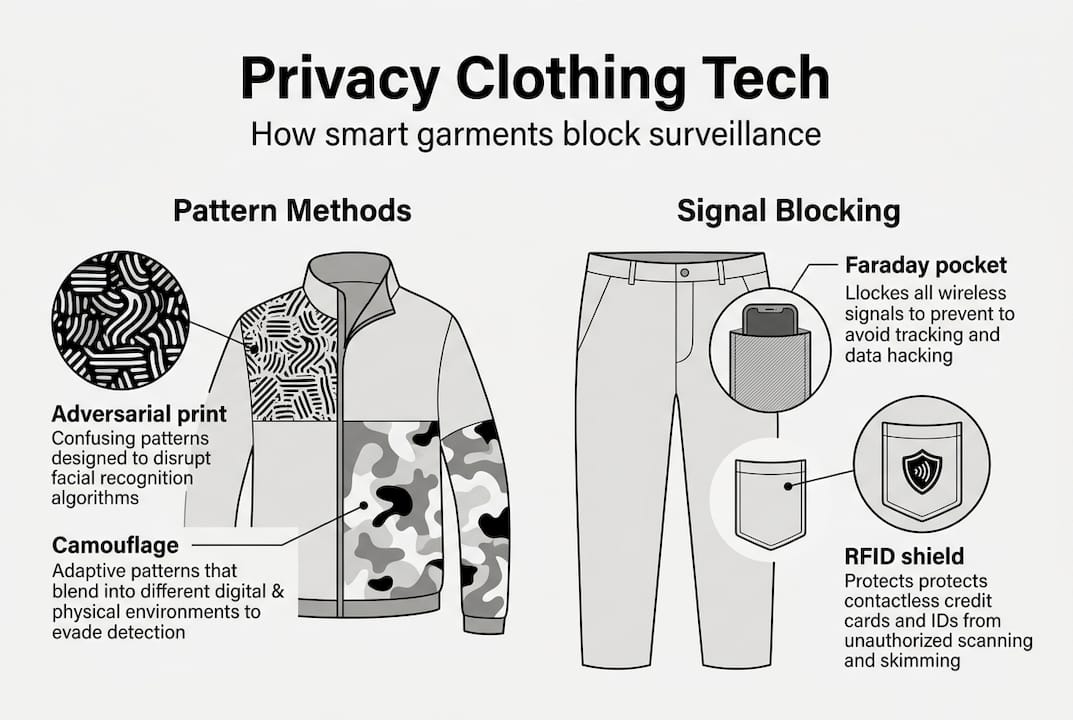
Adversarial patterns are mathematically generated designs printed directly onto fabric. They are engineered to create false positives in AI vision models, essentially feeding the algorithm contradictory data so it cannot correctly identify a face or body. Adversarial patterns use these calculated designs to confuse machine learning models, while Faraday clothing weaves conductive threads through the fabric to block electromagnetic signals. These are not random graphics. Every pixel placement is intentional.
Faraday fabric works on a different principle. Conductive threads, often silver or copper-based, are woven into the garment to create a mesh that absorbs and redirects electromagnetic signals. Think of it as a wearable signal cage. Faraday fabrics achieve shielding effectiveness between 40 and 120 dB across MHz to GHz frequency ranges, which covers most common threats like RFID card skimming, GPS tracking, and cellular interception.
Here is a quick breakdown of what each technology addresses:
- Adversarial patterns: confuse AI facial recognition and object detection cameras
- Faraday pockets and linings: block RFID, NFC, GPS, Wi-Fi, and cellular signals
- Thermochromic dyes: change appearance under heat to disrupt thermal imaging
- Vibration motors (in some experimental designs): create motion noise to confuse motion-based sensors
| Feature | Threat blocked | Effectiveness range |
|---|---|---|
| Adversarial print | AI facial recognition | Up to 75% misclassification |
| Faraday lining | RFID, NFC, GPS, cellular | 40 to 120 dB attenuation |
| Thermochromic dye | Thermal cameras | Variable, heat-dependent |
| Conductive mesh pocket | RFID skimming | High, when fully enclosed |
There are real limitations to acknowledge. Gaps at seams, zippers, and cuffs can reduce signal blocking. Physical wear and repeated washing degrade both printed patterns and conductive threads over time. Understanding fashion security technology basics helps you evaluate claims before you buy.
Pro Tip: Choose garments with reinforced, overlapping seams at all openings. A Faraday pocket with a loose flap is far less effective than one with a sealed magnetic closure.
Types of digital privacy clothing and their privacy functions
With a handle on the technology, it is time to see how these concepts translate into real wardrobe choices.
Digital privacy clothing now spans a surprisingly wide range of everyday garments. You are not limited to bulky tactical gear or conspicuous protest wear. The category has matured into genuinely wearable, stylish pieces that fit naturally into a modern wardrobe.
Hoodies are the most popular category. The Pixel Disruption Hoodie, for example, uses a bold geometric print that scrambles neural networks used in facial detection systems. SLNT jackets integrate Faraday lining throughout to block cellular, Wi-Fi, and GPS signals. Faception T-shirts use face-detection-confusing prints in a lighter, everyday format.
Here is a comparison of the main garment types:
| Garment | Primary privacy function | Style profile | Best use scenario | |—|—|—| | Privacy hoodie | AI facial recognition disruption | Streetwear, cyberpunk | Crowded public spaces | | Faraday jacket | Cellular, GPS, Wi-Fi blocking | Minimalist, urban | Travel, commuting | | Adversarial T-shirt | Face detection confusion | Casual, everyday | Daily wear, events | | Faraday vest | RFID and NFC blocking | Techwear, functional | Airports, transit hubs |
Beyond the tech specs, these garments are increasingly designed with real style in mind. Many come in unisex fits, use eco-friendly conductive materials, and draw from cyberpunk and minimalist aesthetics that feel current rather than costumey. The goal is privacy by design, meaning the protection is built in without announcing itself.
For daily scenarios, consider this:
- Commuting on public transit: a Faraday jacket keeps your phone and cards shielded from skimmers
- Walking through areas with dense CCTV networks: an adversarial hoodie disrupts automated tracking
- Traveling internationally: a Faraday vest protects against passport RFID skimming at checkpoints
- Attending large events: adversarial prints reduce the chance of being flagged by crowd-monitoring AI
Pairing these garments with purpose-built accessories amplifies your protection. RFID-blocking wallets add a dedicated layer of card security that complements what your jacket or hoodie already does. And if you want to understand the broader picture of how digital fashion’s impact is reshaping personal security, the category goes well beyond novelty.
How effective is digital privacy clothing?
Seeing the options gives you a sense of what is out there, but how well do these high-tech clothes actually perform where it matters?
Let’s get into the numbers. Adversarial clothing achieves roughly 75% misclassification rates against standard facial detection systems, while Faraday fabrics reliably block RFID, NFC, and cellular signals up to 85 to 90 dB. That is genuinely impressive performance for something you wear casually.
| Technology | Performance metric | Real-world result |
|---|---|---|
| Adversarial print | 75% AI misclassification | Significant disruption to automated ID |
| Faraday fabric | 85 to 90 dB signal blocking | Effective RFID and cellular shielding |
| Printed pattern (washed 50x) | Significant degradation | Reduced effectiveness over time |
| Conductive thread (worn daily) | Gradual attenuation loss | Needs replacement after heavy use |
“Cap_able’s Manifesto collection achieved 75% ‘orange confidence’ against facial detection systems in controlled tests, a meaningful but not absolute result.”
Here is the important caveat: effectiveness is limited against multi-sensor fusion or advanced AI systems that combine visual, thermal, gait analysis, and behavioral data. A garment that fools one camera may not fool a system that cross-references your walking pattern, phone signal, and purchase history simultaneously.
Performance also degrades with use. Printed adversarial patterns fade with washing. Conductive threads lose conductivity as they break down from friction and repeated laundering. This means the garment that performs at 90 dB on day one may drop significantly after a year of regular wear.
For a clearer picture of how RFID fashion effectiveness holds up in real-world use, and how it compares to purpose-built accessories, it helps to look at dedicated RFID-blocking accessories comparison data alongside garment specs.
Pro Tip: Pair privacy clothing with secure accessories like RFID-blocking wallets and signal-blocking phone pouches. Layering protection across multiple items gives you redundancy that no single garment can provide alone.
The trade-offs and real-world considerations
But numbers only tell part of the story. Wearing digital privacy clothing involves social realities and choices that go beyond specs.
Let’s be direct: adversarial patterns can be conspicuous, raising suspicion from human observers even when they successfully confuse AI systems. The same bold geometric print that scrambles a facial recognition algorithm is also something a security guard or law enforcement officer will notice immediately. Privacy from machines does not equal invisibility to people.
“The hoodie that outsmarts AI may be the one that draws the most human attention in the room.”
There is also a genuine debate around dual-use risks. Privacy advocates argue these garments empower individuals against overreaching surveillance. Critics point out that the same tools could theoretically be used to evade legitimate law enforcement tracking. Both perspectives are worth holding at the same time.
Here is a practical numbered framework for deciding when digital privacy clothing makes sense for you:
- Identify your actual threat model. Are you concerned about RFID skimming, AI surveillance, or GPS tracking? Different threats need different tools.
- Consider your environment. A Faraday jacket is low-key and practical for daily commuting. A bold adversarial hoodie may not be the right call for a business meeting.
- Layer your protection. No single garment covers every threat. Combine clothing with accessories for broader coverage.
- Weigh visibility vs. protection. Some of the most effective adversarial patterns are also the most visually striking. Decide how much attention you are comfortable attracting.
- Plan for maintenance. Build garment care into your routine. Follow washing instructions carefully to extend the life of privacy features.
For most people, the smart move is integrating privacy features into everyday looks rather than treating this as an all-or-nothing commitment. Exploring reasons for RFID-blocking gear helps clarify where the real value lies for your specific routine.

Our take: Why digital privacy clothing is an evolving essential
After weighing the benefits and trade-offs, here is a more nuanced perspective from the front lines of privacy fashion.
Most guides treat digital privacy clothing as either revolutionary or overhyped. We think both camps miss the point. The real value is not perfect anonymity. It is flexibility. A garment that blocks RFID skimming on your morning commute and looks sharp doing it has already earned its place in your wardrobe, even if it cannot fool a military-grade surveillance system.
The hard-won lesson we keep coming back to: the best privacy tool is the one you actually wear. A technically superior Faraday jacket sitting in your closet because it looks like a hazmat suit protects nobody. Integrating privacy features into looks you genuinely want to put on every day is the practical win.
Expect this space to keep evolving fast. AI surveillance is advancing, and so are the countermeasures. Adopt tools thoughtfully, stay informed about what your garments actually do, and resist the urge to over-rely on any single solution. Understanding digital fashion’s impact on personal security is an ongoing process, not a one-time purchase decision. Authenticity and informed intent matter more than chasing total anonymity.
Level up your privacy with stylish gear
Ready to protect your style and your privacy? Here is how you can equip yourself right now.
Digital privacy clothing is a strong foundation, but layering it with purpose-built accessories is where your protection really gets serious. A well-designed RFID-blocking wallet adds dedicated card security that works whether or not you are wearing your Faraday jacket that day. It is the kind of everyday carry that covers your bases without any extra effort.
At InvisiTechWear, we curate tech-forward fashion that does not ask you to choose between looking good and staying protected. From RFID-blocking bags to minimalist wallets and privacy-focused apparel, everything is designed to fit naturally into a modern, security-conscious lifestyle. Browse the collection and find the pieces that match your threat model and your personal style.
Frequently asked questions
Can digital privacy clothing guarantee complete anonymity?
No. Digital privacy clothing significantly reduces digital tracking but cannot guarantee full anonymity, especially against multi-modal surveillance systems that combine visual, behavioral, and signal data.
Do privacy features in clothing work after multiple washes?
Not indefinitely. Both Faraday fabric conductivity and printed adversarial patterns degrade with washing, so following care instructions carefully is essential to maintaining effectiveness over time.
Is digital privacy clothing legal to wear in public?
In most places, yes, but conspicuous adversarial patterns may attract attention from human observers or authorities, even when they successfully confuse automated systems.
Can I block RFID skimming with privacy clothing alone?
Some garments with Faraday pockets reliably block RFID, but pairing them with dedicated RFID-blocking accessories gives you stronger, more consistent protection across all your cards and devices.
How do I choose the right digital privacy garment for my needs?
Start by identifying your primary threat, whether that is AI cameras, RFID skimming, or GPS tracking, then match garment features and style to the specific scenarios you encounter most in your daily routine.


