

TL;DR:
- Modern security apparel offers RFID blocking, slash resistance, and discreet protection integrated into stylish clothing.
- Identifying specific threats helps determine necessary features like RFID shielding, hidden pockets, or ballistic inserts.
- Effective protection combines subtle, well-fitting garments with layered security measures and blending into the urban environment.
Urban professionals face a quiet but real threat every day. Pickpockets work crowded subway platforms. Digital skimmers target contactless cards in coffee shop lines. Yet most security gear looks tactical, bulky, or just plain wrong with a tailored blazer. The good news is that security-focused apparel has evolved far beyond cargo pants and vests. Today, you can find RFID-blocking fabrics, slash-resistant linings, and hidden pockets built into clothing that looks sharp in a boardroom. This guide walks you through identifying your actual security needs, understanding which features matter, evaluating quality, and shopping with confidence.
Table of Contents
- Identify your security and style needs
- Understand essential security features
- Evaluate quality, comfort, and accreditation
- Shop smart: Brands, products, and where to buy
- The overlooked truth: Security is often about blending in
- Enhance security and style with trusted picks
- Frequently asked questions
Key Takeaways
| Point | Details |
|---|---|
| Match needs with features | Choose security apparel based on the threats you face (RFID, theft, ballistic) and your daily style. |
| Demand certified protection | Look for third-party lab results and certifications, not just marketing claims. |
| Prioritize real-world usability | Comfort, fit, and integration with your wardrobe are just as critical as security specs. |
| Shop trusted brands | Buy from reputable brands with positive reviews, style-forward designs, and proven durability. |
Identify your security and style needs
Before you spend money on any security-focused piece, you need to be honest about what you’re actually protecting against. Not every threat applies to every lifestyle, and buying gear for threats you don’t face wastes money and often adds unnecessary bulk.
There are three main categories of threats urban professionals deal with:
- Electronic skimming (RFID theft): Criminals use handheld readers to steal data from contactless credit cards, passports, and key fobs without ever touching you. This is especially common in dense urban areas.
- Physical theft (pickpocketing): Crowded transit, tourist areas, and busy markets create opportunities for fast-handed thieves to access open pockets or loose bags.
- Personal protection (ballistic): A smaller segment of professionals, particularly those working in high-risk zones or traveling internationally, look for discreet ballistic panels or protective inserts.
Once you know your threat level, match it to your wardrobe context. Are you dressing for a professional office environment? A daily commute? Weekend travel? Each setting calls for a different balance of protection and aesthetics. A gray man blending approach, which means dressing to avoid drawing attention, works well across all three contexts and keeps your look clean and unremarkable in the best possible way.
Understanding RFID protection basics is a smart starting point if electronic skimming is your primary concern. And if you commute through busy city centers, pairing RFID protection with urban fashion security accessories rounds out a practical daily setup.
Pro Tip: Write down the three places you spend the most time each week. Then ask yourself which threat is most realistic in each location. That exercise alone will cut your shopping list in half.
| Lifestyle context | Primary threat | Recommended feature |
|---|---|---|
| Daily office commute | RFID skimming | RFID-blocking wallet or jacket lining |
| International travel | Pickpocketing | Hidden pockets, slash-resistant fabric |
| High-risk environments | Physical harm | Discreet ballistic inserts |
| Urban leisure | Mixed | Neutral colors, hidden zippers |
Understand essential security features
Once you’ve identified your needs, it’s time to break down which security features actually matter for your wardrobe. Marketing language can be misleading, so knowing what to look for technically puts you ahead.
RFID-blocking fabric uses metal-coated yarns woven into the material to disrupt radio frequency signals. Look for products that list actual SE dB (shielding effectiveness in decibels) ratings rather than vague claims. A rating of 60 dB or higher is generally considered reliable. It’s worth noting that RFID blocking is debated as overhyped by some, but security experts still recommend it for urban travel where contactless theft is documented.

One important technical detail: many budget RFID products only block HF (high frequency) signals at 13.56 MHz, which covers most modern credit cards. But some older key fobs and transit cards use UHF (ultra-high frequency) signals. Make sure the product you buy specifies which frequencies it blocks.
Anti-theft design goes beyond fabric. Look for:
- Hidden zipper pockets inside waistbands or jacket linings
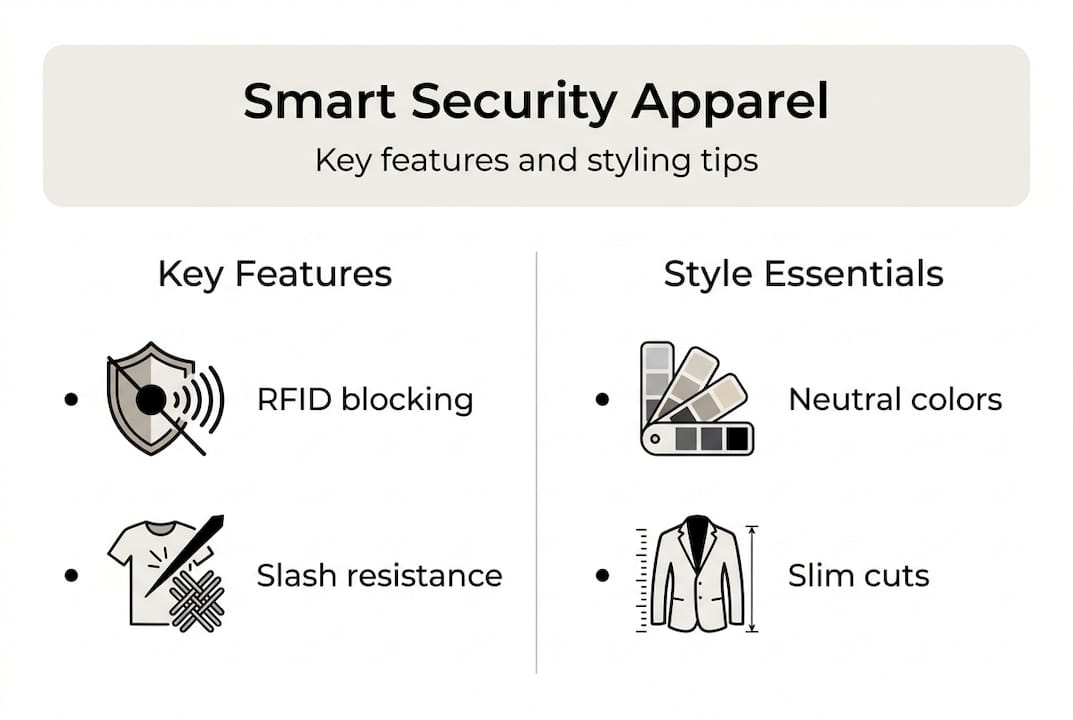
- Slash-resistant panels made from reinforced fibers like Dyneema or stainless steel mesh
- Lockable zippers with small loops that attach to belt loops or bag straps
- Deep, angled pockets that make it physically hard to reach inside without your awareness
For those interested in RFID blocking explained in more detail, the technology is more accessible than most people expect. And choosing RFID-blocking accessories alongside your apparel creates layered protection that’s much harder to defeat.
Ballistic and gray man elements are for a specific audience. Discreet protective inserts can be added to certain jackets without changing the silhouette. Motorcycle jacket reviews show how modern protective gear has evolved to look nearly identical to regular fashion outerwear, which is exactly the direction the broader security apparel market is heading.
“The best security apparel is the kind nobody notices. If your jacket screams ‘tactical,’ you’ve already drawn attention to yourself.”
For women, fit matters even more when ballistic or protective inserts are involved. Many inserts are designed for male torso shapes and create awkward bulk on female cuts. Always check whether a brand offers women-specific sizing for any protective layer.
Evaluate quality, comfort, and accreditation
After understanding basic features, it’s crucial to focus on long-term wearability and reliability. A jacket that protects you but sits in your closet because it’s uncomfortable isn’t doing its job.
Here’s a step-by-step process for evaluating any security-focused garment before buying:
- Check certifications. Look for Oeko-Tex Standard 100 for fabric safety, SE dB and UL94 ratings for shielding and flame resistance, and CE abrasion ratings for any protective outerwear. These aren’t just marketing badges. They represent third-party lab testing.
- Read the fabric composition. Breathable blends like merino wool, nylon-spandex, or moisture-wicking polyester hold up better through long workdays than pure cotton. If you’re commuting in summer heat, breathability is non-negotiable.
- Look at wash cycle guidance. Some RFID-blocking fabrics degrade after repeated washing. Check whether the shielding is embedded in the yarn itself (more durable) or applied as a coating (less durable over time).
- Assess the fit. Security apparel used to mean boxy, oversized cuts that hid protective layers. Today, the best brands engineer slim, contemporary fits that work for professional environments. A tailored look is achievable without sacrificing coverage.
- Read independent reviews. User reviews from verified buyers often reveal comfort issues that product descriptions skip, like stiff collars, heavy linings, or pockets that sit awkwardly when seated.
Pro Tip: If a brand won’t share its certification documentation on request, treat that as a red flag. Reputable manufacturers are proud of their test results and make them easy to find.
For a broader look at what separates functional fashion from gimmick gear, the fashion tech essentials breakdown is a useful reference when building a security-conscious wardrobe from scratch.
Shop smart: Brands, products, and where to buy
With knowledge of quality and certifications in hand, you’re ready to make informed shopping decisions. The market has grown significantly, and several brands have earned strong reputations for combining real security features with genuinely wearable style.
Recommended brands in the security apparel space include Bluffworks, Western Rise, Pacsafe, CivilianCo, and Aviator Jeans. Each approaches the balance of style and security differently, so knowing your primary use case helps narrow the choice.
Where to buy:
- Direct from brand websites: You get the most complete product information, sizing guides, and return policies. Brands like Bluffworks and Western Rise sell primarily direct.
- Specialty travel and security retailers: Stores like Pacsafe’s own site or curated security fashion retailers offer side-by-side comparisons.
- Tech-fashion ecommerce platforms: Sites focused on functional fashion often carry curated selections with editorial context, making it easier to compare features across brands.
| Brand | Strength | Best for |
|---|---|---|
| Bluffworks | Wrinkle-resistant, professional cuts | Office and travel |
| Western Rise | Premium fabric, slim fit | Urban commuting |
| Pacsafe | Anti-theft bags and apparel | Travel and transit |
| CivilianCo | Discreet protective inserts | High-risk environments |
| Aviator Jeans | Hidden pockets, denim aesthetic | Casual urban wear |
When shopping, prioritize neutral colors like navy, charcoal, and olive. These shades work across professional and casual contexts and don’t signal “security gear” to anyone watching. Understanding RFID fashion effectiveness helps you separate genuinely protective products from those that simply use the term as a marketing hook. And if you’re still weighing whether the investment is worth it, the case for why buy RFID-blocking gear is straightforward once you understand how common contactless skimming has become in dense urban areas.
The overlooked truth: Security is often about blending in
Here’s something most security gear marketing won’t tell you: the most effective protection often has nothing to do with the fabric. It’s about not looking like a target in the first place.
The gray man philosophy centers on slim cuts and neutral colors like navy and olive specifically because they make you forgettable in urban crowds. A pickpocket scans for easy marks, and someone dressed in unremarkable, well-fitted clothing reads as lower value and harder to access than someone in a flashy outfit with obvious pockets.
We see a lot of urban professionals over-invest in technical features they’ll never need while ignoring the basics. An RFID-blocking jacket means nothing if you’re wearing it with a bag that hangs open at your side. Subtlety is a feature. A garment that looks expensive but not flashy, fits well, and keeps your valuables close is doing more security work than most people realize.
For everyday use, a well-chosen RFID wallet for urban style paired with a clean, neutral jacket often outperforms a head-to-toe tactical setup that draws curious looks. Overhyped features sell gear. Understated functionality protects you.
Enhance security and style with trusted picks
If you’re ready to put these tips into action, the right products are closer than you think.
At InvisiTechWear, we curate security-focused apparel and accessories built for urban professionals who refuse to choose between looking sharp and staying protected. Start with something practical and impactful: the RFID-blocking slim wallet is a clean, minimalist upgrade that blocks electronic skimming without adding bulk to your pocket. From there, explore our full range of tech-infused jackets, hoodies, and accessories designed to work as hard as your wardrobe does. Every pick is chosen for real-world functionality, not just marketing claims.
Frequently asked questions
What is RFID-blocking fabric and does it really work?
RFID-blocking fabric uses metal-coated yarns to disrupt electronic signals and prevent contactless data skimming. When a product carries verified SE dB ratings from third-party testing, it offers reliable protection in urban environments.
Are anti-theft pockets really effective in preventing pickpocketing?
Hidden zippers and slash-resistant pockets significantly raise the difficulty for thieves in crowded transit and city centers. Combined with body awareness and neutral styling, they form a practical and low-profile defense.
How do I know if my security-focused apparel is comfortable for all-day wear?
Look for breathable materials and slim fits and prioritize verified user reviews that specifically mention comfort during commutes or long workdays. Certifications like Oeko-Tex also confirm the fabric is safe against skin for extended wear.
What certifications should I check for when buying security apparel?
For fabric safety, look for Oeko-Tex Standard 100. For shielding performance, check SE dB and UL94 ratings, and for any protective outerwear, CE abrasion ratings confirm the material has been independently tested for durability.


