

TL;DR:
- Modern smart clothing merges sensors and protection seamlessly into stylish garments.
- Prioritize materials like RFID-blocking fabric and concealed sensors to ensure durability and function.
- Regular testing and careful maintenance are essential for reliable performance of smart apparel.
Your favorite jacket looks sharp, but it can’t block RFID skimmers or control your playlist hands-free. That gap between looking good and staying protected is exactly where modern professionals get stuck. Smart fashion is closing that gap fast, merging sensors, anti-theft materials, and wireless connectivity directly into everyday garments. This guide walks you through every step: identifying your real needs, choosing the right materials, building a functional wardrobe, avoiding common mistakes, and verifying that your clothes actually deliver on their promises.
Table of Contents
- Understand your needs: Security, convenience, and style
- Prepare: The essential materials and features checklist
- Step-by-step: Optimizing your wardrobe for modern life
- Avoid pitfalls: Common mistakes and troubleshooting tips
- Measuring success: Verifying enhanced clothing functionality
- Our take: Why functionality and style must grow together
- Discover functional fashion solutions for your lifestyle
- Frequently asked questions
Key Takeaways
| Point | Details |
|---|---|
| Balance is key | The best functional clothing combines style, comfort, and innovative tech for seamless daily use. |
| Choose reliable features | Prioritize durability, washability, and integrated sensors that meet your actual lifestyle needs. |
| Stay proactive | Regularly test and maintain your tech-enhanced clothing to ensure long-term performance and security. |
| Start small | Upgrade with essentials like RFID-blocking accessories for instant functionality without sacrificing style. |
Understand your needs: Security, convenience, and style
Before you spend a single dollar on tech-enabled apparel, you need to get honest about what you actually need from your clothes. Most people shop by look first and function never. That’s a mistake when your commute, your data, and your daily comfort are all on the line.
Start by asking yourself three questions. What’s the biggest daily friction point in your life? Is it fumbling for your phone on the subway? Worrying about card skimming in crowded spaces? Needing health data without wearing a clunky fitness band? Your answers shape everything that follows.
Here are the most common functional priorities for modern professionals:
- Security: RFID-blocking layers, anti-theft zippers, hidden pockets, and tamper-resistant closures
- Convenience: Hands-free device controls, contactless payment integration, and quick-access storage
- Health monitoring: Embedded heart rate sensors, posture correction alerts, and activity logging
- Safety: Impact protection and fall detection for cyclists, commuters, and outdoor workers
- Aesthetics: Clean lines, neutral colors, and sensor concealment that keeps the tech invisible
Smart textiles have moved well beyond novelty. Smart clothing can provide hands-free control and impact protection, which means your wardrobe can literally do things your phone can’t do while it’s buried in your bag. That’s a real shift in how we think about getting dressed.
The art of blending style with function is no longer reserved for tech companies or military gear designers. It’s available to anyone willing to shop with intention. And knowing your smart clothing features before you browse saves you from impulse buys that look cool but don’t solve your actual problems.
Pro Tip: Write down your top three non-negotiable features before you open any product page. If a garment doesn’t check all three, keep scrolling.
Prepare: The essential materials and features checklist
Once you’ve clarified your functional priorities, it’s crucial to know which materials and features will truly deliver. Not all smart textiles are created equal, and the difference between a gimmick and a genuinely useful garment often comes down to the materials inside.
Here’s a breakdown of the core smart textile technologies worth knowing:
| Technology | Primary benefit | Best use case |
|---|---|---|
| RFID-blocking fabric | Blocks electronic pickpocketing | Wallets, bags, jacket pockets |
| Conductive thread sensors | Tracks biometrics and motion | Fitness shirts, posture garments |
| Airbag deployment systems | Absorbs fall impact instantly | Cycling jackets, outdoor gear |
| Low-power Bluetooth | Wireless device connectivity | Earphone organizers, control panels |
| Moisture-wicking e-textiles | Maintains sensor function during sweat | Athletic and commuter wear |
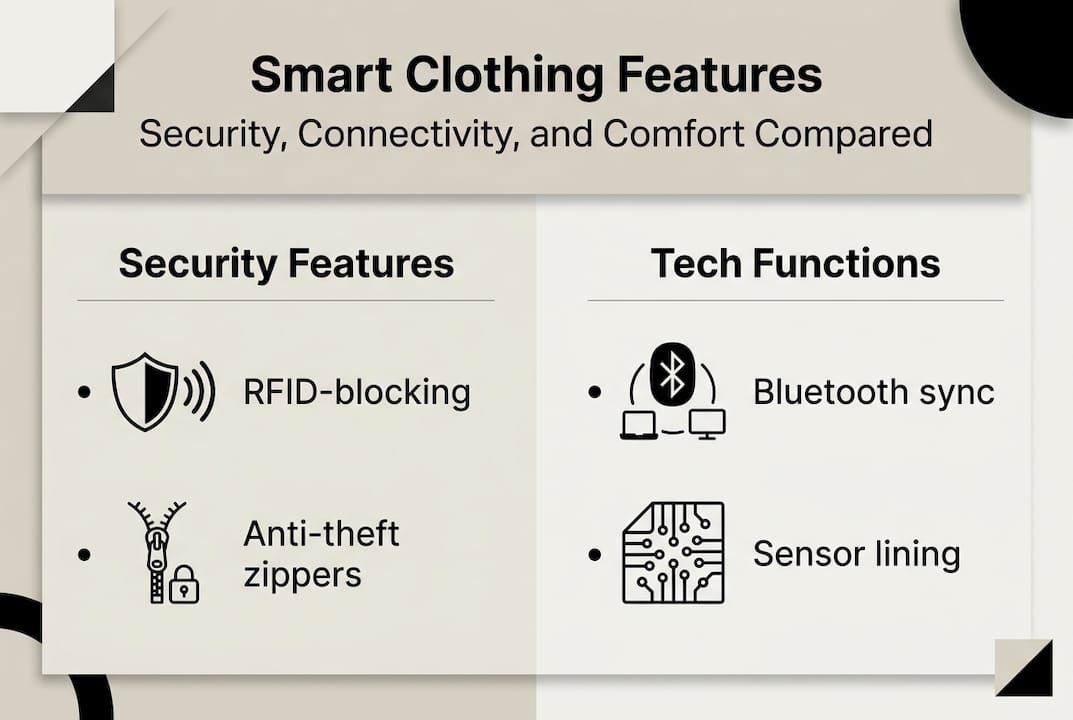
The hands-free smart textile controls category is especially exciting because it removes the need to touch your phone entirely. Imagine adjusting your music volume by pressing a spot on your sleeve while cycling in the rain.
On the safety side, the IND-AIR airbag jacket deploys in 100-120ms on fall detection, and SeamFit T-shirts log physical activity using AI-powered seam-based sensors. These aren’t concepts. They’re production-stage garments proving that wearable safety tech is ready for daily life.
When evaluating any smart garment, check for these must-have qualities:
- Washability: Can the electronics survive a standard machine wash cycle?
- Battery life: Does it need daily charging or does it run on low-power passive tech?
- Sensor concealment: Are the tech components visible or seamlessly integrated?
- Device compatibility: Does it pair with iOS and Android, or only one ecosystem?
- Durability rating: What’s the expected lifespan of the embedded components?
Exploring innovative fashion trends helps you stay ahead of what’s entering the market, while understanding smart clothing types helps you match the right category to your lifestyle.
Pro Tip: Prioritize low-power passive features like RFID-blocking over active electronics if you want zero maintenance. Save the battery-dependent features for specific use cases where the payoff is clear.
Step-by-step: Optimizing your wardrobe for modern life
Armed with a checklist of features and materials, here’s exactly how to build a functional and stylish wardrobe.
- Audit your current wardrobe. Pull out every item you wear at least twice a week. Note what’s missing: hidden pockets, RFID protection, or any tech integration at all.
- Rank your use cases. Are you optimizing for the office commute, weekend travel, or active outdoor use? Each context demands different features.
- Choose your approach. Decide between modular accessories (add-on tech like RFID wallets or Bluetooth organizers) versus all-in-one garments (jackets with built-in controls or sensor shirts).
- Shop with your checklist. Use the feature table from the previous section as a filter. If a product doesn’t list washability specs or battery details, that’s a red flag.
- Test before committing. Wear each new piece for a full workday before deciding it’s a keeper. Comfort and connectivity issues show up fast in real conditions.
- Integrate gradually. Don’t overhaul everything at once. Start with one high-impact swap, like replacing your standard wallet with an RFID-blocking version, then layer in more tech over time.
Flexible sensors embedded with braiding and knitting techniques offer both durability and seamless device connectivity, which means the best smart garments flex and move with you rather than restricting your range of motion.
Here’s a quick comparison to help you decide between the two main integration approaches:
| Approach | Pros | Cons |
|---|---|---|
| Modular accessories | Easy to swap, lower cost, flexible | Requires carrying extra items |
| All-in-one garments | Seamless, hands-free, fully integrated | Higher cost, harder to replace |
For security-focused buyers, wearable tech examples show how RFID-blocking and anti-theft features can look completely normal. For style-focused buyers, styling wearable tech proves that functional doesn’t mean frumpy. And if you want the full picture on how tech and garments merge, integrated smartwear breaks it all down clearly.

The airbag jacket and SeamFit T-shirt study is worth reading if you’re serious about safety-focused smart clothing. Real-world performance data matters more than marketing copy.
Avoid pitfalls: Common mistakes and troubleshooting tips
Even the best-built wardrobe faces obstacles. Here’s how to sidestep them and fix common issues before they become expensive regrets.
The most frequent mistake is choosing style over durability. A jacket might look incredible but use sensors that fail after three washes. Always check the care label and the product’s IP rating (ingress protection, meaning resistance to water and dust) before buying.
Other common errors include:
- Ignoring battery life: Active smart garments need charging. If you forget, the tech goes dark exactly when you need it most.
- Poor device compatibility: Some smart garments only pair with specific apps or operating systems. Verify compatibility before purchase.
- Overlooking fit: Sensors embedded in the wrong position on your body won’t read accurately. Smart shirts especially need a snug, consistent fit.
- Underestimating maintenance: Conductive threads can degrade if washed incorrectly. Always follow the manufacturer’s washing instructions exactly.
“Balancing fashion, comfort, and technology is still a challenge, especially regarding washability and energy management in wearable systems.”
That quote reflects a real tension in the industry. Brands are working on it, but you as a consumer need to stay sharp. If a product claims to be fully waterproof and machine washable with active electronics inside, dig into the reviews before trusting that claim.
Troubleshooting connectivity issues is usually straightforward. Reset the Bluetooth pairing, update the companion app, and make sure the garment’s battery is above 20% before testing. Fit issues require more patience: try a different size, adjust the garment’s position, and re-run the calibration sequence if the app offers one.
For a broader view of how blending technology and style is evolving, and what secure style in 2026 actually looks like in practice, those resources fill in the gaps that product pages leave out.
Measuring success: Verifying enhanced clothing functionality
Once your smart wardrobe is set, here’s how to ensure everything functions at its best.
Verification isn’t a one-time event. It’s an ongoing habit, just like charging your phone or updating your apps. The good news is that low-power Bluetooth connectivity and embedded sensors enable real-time feedback and reliable alerts, so most smart garments will tell you when something’s off.
Here’s your verification checklist:
- Connectivity test: Pair the garment with your device and confirm all features respond correctly within 10 seconds
- Sensor accuracy check: Compare the garment’s health readings against a known-accurate device like a medical-grade pulse oximeter
- RFID protection test: Use a card reader app to confirm your protected cards are unreadable when stored in the garment
- Wash durability check: After every 10 washes, rerun the connectivity and sensor tests to catch any degradation early
- App update review: Check for firmware or app updates monthly. Manufacturers push performance improvements regularly
- Physical inspection: Look for fraying near sensor seams or connector points, which signals wear before failure
For a deeper look at how tech fashion accessories stack up across different performance metrics, that comparison gives you a real-world benchmark.
Pro Tip: Set a recurring calendar reminder every 30 days to run through your verification checklist. Five minutes of testing can prevent weeks of wearing gear that’s silently underperforming.
Our take: Why functionality and style must grow together
Here’s the uncomfortable truth most smart fashion brands won’t say out loud: treating tech as a feature add-on is the wrong model entirely. When a brand bolts a sensor onto an existing garment and calls it smart, the result is always awkward. The sensor placement is wrong, the aesthetic is off, and the user experience suffers.
The garments that actually work are the ones where the technology was designed into the fabric from the start, not sewn on afterward. That’s why fashion meets technology isn’t just a marketing phrase. It’s an engineering requirement.
We believe the future of smart clothing is invisible tech and visible style. You should never have to explain to someone that your jacket is “smart.” It should just look like a great jacket that happens to protect your cards, monitor your heart rate, and let you skip a song without touching your phone. That seamless experience is the only standard worth holding brands to.
Form and function are not competing values. They’re the same value, expressed differently.
Discover functional fashion solutions for your lifestyle
Ready to put these ideas into action? Here’s where to start.
If you want an immediate, zero-effort security upgrade, an RFID blocking wallet is the fastest win available. It protects your cards from electronic skimming without changing how you dress or carry your essentials. Slim, stylish, and built for daily use, it’s the kind of functional upgrade that pays off every single day.

For a broader look at what’s possible, smart fashion at InvisiTechWear brings together apparel and accessories that are built for people who refuse to choose between looking sharp and staying protected. Browse the full collection and find the pieces that fit your lifestyle and your standards.
Frequently asked questions
What are the top features to look for in functional smart clothing?
Prioritize RFID-blocking, embedded sensors, washability, Bluetooth connectivity, and anti-theft design. Smart clothing offers hands-free device control and improved safety, making these features genuinely practical for daily wear.
How do wearable airbags and sensor shirts work?
Airbag jackets detect a fall and deploy protection within milliseconds, while sensor shirts log physical activity through AI-powered seam-based threads. The IND-AIR and SeamFit garments are current examples of both technologies in production-ready form.
Do smart clothing features make maintaining style harder?
Not with the right brands. Today’s best smart garments use flexible sensors and thoughtful design to keep tech completely invisible. Balancing tech, comfort, and style is an active focus of smart fabric innovation, and the results are getting better every year.
How can I make sure my tech-enhanced clothes stay reliable?
Test connectivity after every wash, follow care instructions precisely, and update your companion app monthly. Bluetooth pairing and embedded sensors need regular software updates to maintain accuracy and reliability over time.


