

Most people picture wearable tech as chunky smartwatches or rigid fitness trackers strapped awkwardly to your wrist. That image is outdated. Modern e-textiles, meaning garments and accessories with technology woven directly into the fabric, are seamlessly integrated for comfort, flexibility, breathability, and natural hand-feel without any bulky gadgets. If you’ve been waiting for wearable tech that actually fits your lifestyle and wardrobe, this is the moment to pay attention. We’ll walk you through what makes e-textiles genuinely different, how their security features work, what materials power them, and why they’re becoming the go-to choice for urban professionals who refuse to compromise on style.
Table of Contents
- What makes e-textiles revolutionary for urban style?
- Integrated security and personalization features
- Advanced materials and manufacturing methods
- Daily advantages: Performance, personalization, and durability
- Eco-friendly and sustainable e-textile solutions
- Overcoming challenges: Durability, washing, and data security
- Discover the best e-textile accessories for your lifestyle
- Frequently asked questions
Key Takeaways
| Point | Details |
|---|---|
| Seamless tech integration | E-textiles deliver invisible tech enhancements within stylish, comfortable accessories. |
| Advanced security features | Integrated biometric authentication and RFID protection set new standards for urban safety. |
| Eco-friendly and durable | Modern e-textiles use biodegradable materials and excel in real-world durability, ideal for daily use. |
| Personalized performance | Accessories built from e-textiles offer real-time monitoring and individual customization. |
| Easy care and maintenance | Innovative designs now support extended washability and robust function, simplifying urban living. |
What makes e-textiles revolutionary for urban style?
The biggest shift e-textiles bring isn’t just technical. It’s personal. Traditional tech accessories sit on top of your outfit. E-textiles become part of it. The technology lives inside the fiber itself, so there’s nothing to clip, strap, or attach. You get the function without the visual noise.
Here’s what sets them apart from conventional wearable tech:
- Comfort first: Fabrics are engineered to feel like premium clothing, not hardware.
- Invisible integration: Sensors, conductors, and smart components are woven in, not bolted on.
- Breathability: Advanced fiber construction maintains airflow, so you stay comfortable all day.
- Style flexibility: E-textiles work across casual, business, and athletic contexts without looking out of place.
- Adaptability: They move with your body, not against it.
The numbers back this up. A striking 78% of smart apparel buyers say comfort is the primary reason they come back for repeat purchases. That’s not a coincidence. It reflects a deliberate design philosophy that puts the wearer first.
“For urban professionals, e-textiles offer tech-integration with comfort and aesthetics that traditional wearables simply can’t match.”
If you want a deeper look at how this plays out in real garments, the advantages of tech-infused clothing are worth exploring. And if you’re new to the category, our smart fabric guide breaks down exactly how these materials work in everyday apparel. The integration of e-textiles into fashion is no longer a future concept. It’s already in your closet, or it should be.
Now that we’ve clarified how e-textiles are redefining the wearable tech landscape, let’s dig deeper into their innovative security features.
Integrated security and personalization features
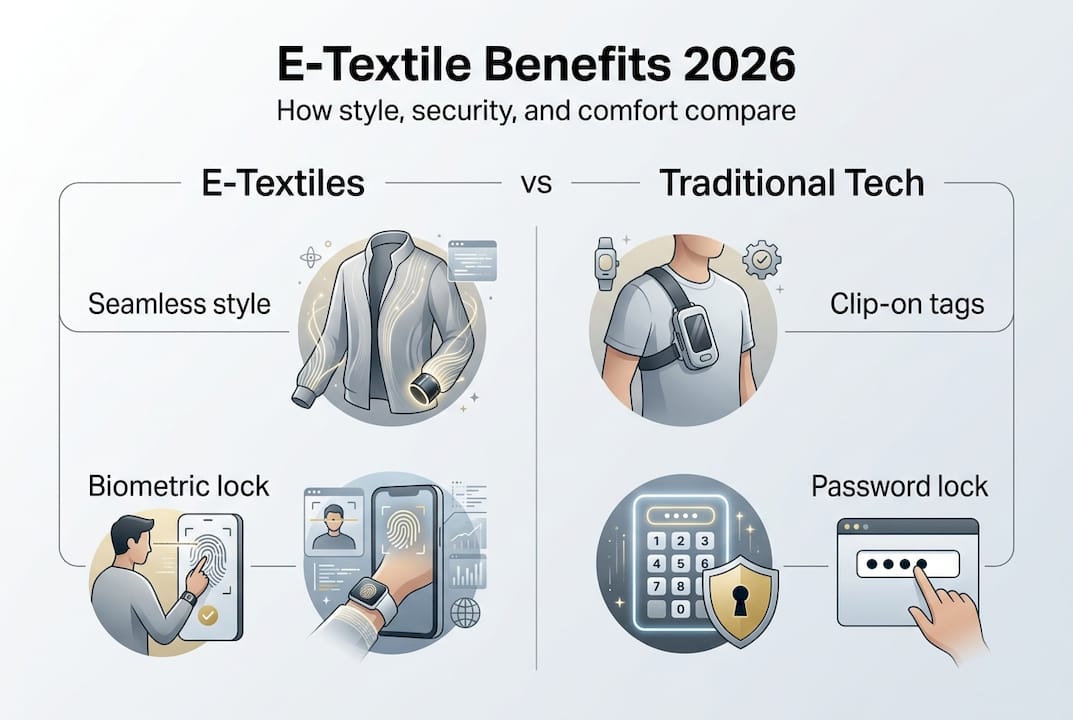
Security in fashion used to mean a hidden pocket or a zipper. E-textiles raise that bar significantly. Conductive fibers woven into the fabric can power sophisticated sensors capable of user authentication, meaning your garment can recognize you specifically.
Here’s how biometric authentication works in an e-textile accessory:
- Sensor activation: Conductive threads in the fabric detect contact or pressure from your body.
- Data capture: The embedded sensor reads a biometric signal, such as a fingerprint pattern or vein structure.
- Signal processing: A micro-controller within the garment processes the data in real time.
- Authentication decision: The system grants or denies access based on your unique biometric profile.
- Encrypted output: Any transmitted data is encrypted before leaving the garment.
This isn’t theoretical. Conductive threads achieve biometric authentication accuracy of 98.5%, which outperforms many standalone security devices. That level of precision makes e-textiles a serious option for professionals who carry sensitive data or need reliable access control.
| Feature | E-textiles | Traditional tech accessories |
|---|---|---|
| Biometric authentication | Yes, woven-in sensors | Rarely, requires add-on hardware |
| RFID blocking | Integrated into fabric | Requires separate lining or case |
| Data encryption | On-device, real-time | Often cloud-dependent |
| Physical profile | Slim, fabric-based | Bulky, rigid |
| Personalization | Programmable per user | Limited or fixed settings |
For a full breakdown of how biometric features are being built into modern garments, the biometric clothing guide covers the latest developments. You can also explore integrated smartwear security to understand how these systems work together in a complete outfit.
Pro Tip: When shopping for e-textile accessories, look specifically for products that offer customizable biometric profiles. A garment that learns your unique patterns provides far stronger protection than one with a fixed security setting.
Security is just one facet of e-textiles. Let’s examine how construction and durability are advancing to meet the demands of urban life.
Advanced materials and manufacturing methods
The performance of any e-textile starts with its materials. Three names come up repeatedly in high-performance smart apparel: graphene, PEDOT:PSS (a conductive polymer), and conductive yarns. Each brings something different to the table.
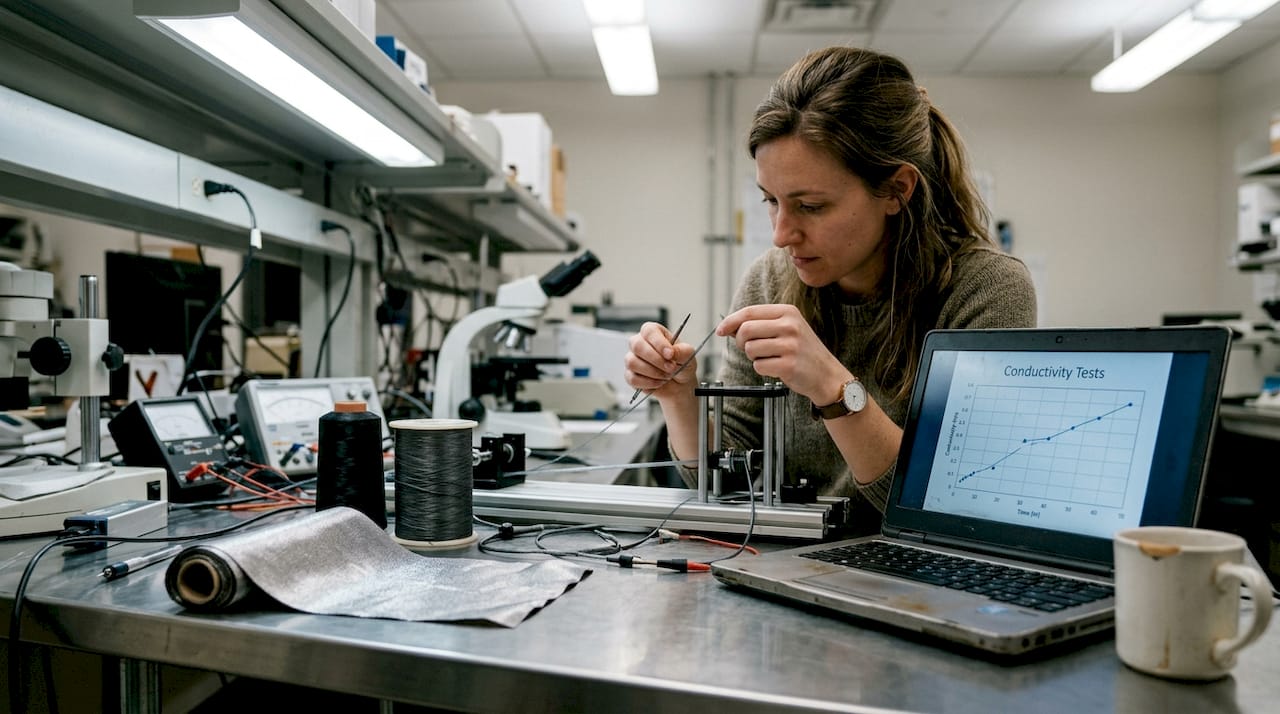
Graphene-infused fibers are exceptionally strong, lightweight, and electrically conductive. PEDOT:PSS is a flexible polymer that maintains conductivity even when stretched repeatedly. Conductive yarns blend metallic threads with traditional fibers to create fabrics that carry electrical signals without sacrificing softness.
Manufacturing methods matter just as much as materials:
| Method | Key benefit | Best use case |
|---|---|---|
| Knitting | Maximum stretch and comfort | Athletic and casual wear |
| Weaving | High durability and structure | Bags, jackets, and outerwear |
| 3D printing | Precise component placement | Custom accessories and wearables |
| Embroidery | Fine detail and aesthetic appeal | Decorative tech elements |
Material advantages worth knowing:
- Durability: Graphene-based fibers resist wear and maintain conductivity over thousands of use cycles.
- Flexibility: Conductive yarns stretch and recover without breaking the electrical circuit.
- Style: PEDOT:PSS can be applied in thin, nearly invisible layers that don’t alter the garment’s appearance.
- Washability: Modern conductive materials are engineered to survive repeated laundering.
The smart textile market is projected to exceed $13 billion by 2027, driven largely by these material breakthroughs. Urban fashion brands are already adopting graphene-infused fibers for their combination of strength and visual appeal. Our smart fabric guide goes deeper on material science, and the fabric innovation space is moving fast enough that what’s cutting-edge today will be standard within two years.
With materials and methods covered, let’s focus on the everyday advantages and realistic performance metrics that matter to you.
Daily advantages: Performance, personalization, and durability
Knowing the science is useful. Knowing how it holds up on a Tuesday morning commute is what actually matters. E-textiles are built for real-world conditions, not just lab demonstrations.
Here’s what you get in daily use:
- Real-time health monitoring: Heart rate, temperature, and movement data collected passively as you wear the garment.
- Safety enhancements: Integrated sensors can detect falls, unusual biometric changes, or environmental hazards.
- Personalized settings: Your garment adapts to your preferences, from fit adjustments to security configurations.
- Style options: Smart components don’t change the visual profile of the garment. You look sharp. The tech stays hidden.
The durability numbers are genuinely impressive. E-textile performance remains stable over 10,000 cycles at 30% strain, with a gauge factor of 11.07. That’s engineering language for: these garments hold up under serious, repeated stress.
“E-textiles designed for urban use maintain consistent electrical and mechanical performance across thousands of wear cycles, making them a reliable choice for daily professional use.”
For a practical look at how these benefits translate to your wardrobe, the tech-infused clothing benefits page is a solid starting point. And when it comes to keeping your investment in top shape, knowing how to maintain smart clothing makes a real difference in long-term performance.
Pro Tip: When evaluating e-textile products, ask specifically about cycle testing ratings. A garment rated for 10,000 cycles at high strain is built to last years of daily use, not just months.
For many readers, sustainability is as important as performance. Let’s examine how e-textiles help support eco-conscious lifestyles.
Eco-friendly and sustainable e-textile solutions
Fashion has a well-documented environmental problem. E-textiles, particularly those built with next-generation materials, are actively working against that trend rather than adding to it.
The most exciting development in sustainable e-textiles is biodegradable graphene-based fabric. Biodegradable e-textiles decompose in soil within four months and carry a 40x lower environmental footprint compared to traditional tech-embedded garments. That’s a meaningful difference, not a marginal one.
Sustainability benefits of modern e-textiles:
- Compostable fibers: Select graphene-based fabrics break down naturally without releasing toxic residues.
- Lower production footprint: Advanced manufacturing methods reduce water and energy consumption versus conventional textile production.
- Longer product lifespan: High durability means fewer replacements and less waste over time.
- Reduced packaging: Slim, integrated designs eliminate the need for bulky protective packaging.
If sustainability is a priority for you, our guides on sustainable techwear and eco-friendly tech-wear offer practical guidance on making greener choices. The sustainable fashion tech space is growing quickly, and the options available in 2026 are far more sophisticated than even two years ago.
Pro Tip: Look for e-textile products that carry third-party environmental certifications. Labels like OEKO-TEX or certifications from recognized sustainability bodies confirm that the product meets verified environmental standards, not just marketing claims.
Even with all these advances, e-textiles face unique challenges. Let’s review what you need to know for practical, long-term use.
Overcoming challenges: Durability, washing, and data security
No technology is without trade-offs. E-textiles have two main concerns that come up consistently: how they hold up in the wash, and whether the data they collect stays private. Both are legitimate questions, and both have solid answers.
On washing durability, recent engineering advances have been significant. E-textiles now maintain performance after 100 machine washing cycles and 24 days of continuous immersion. That’s a benchmark that covers years of normal use.
Steps to make your e-textiles last longer:
- Use cold water cycles: Heat degrades conductive fibers faster than mechanical action does.
- Turn garments inside out: Protects surface-level conductive elements from abrasion.
- Use mesh laundry bags: Reduces mechanical stress on embedded components.
- Avoid fabric softeners: Chemical residues can coat conductive fibers and reduce performance.
- Air dry when possible: High dryer heat is the single biggest threat to e-textile longevity.
“Modern e-textiles engineered for urban use can withstand 100 washing cycles without measurable performance loss, making maintenance straightforward for daily wearers.”
On data security, multi-layer encryption built directly into the garment’s micro-controller means your biometric and health data doesn’t leave the device unprotected. This is a significant improvement over early wearables that relied on cloud transmission for basic functions. For hands-on care guidance, how to clean tech-infused clothing and how to maintain smart clothing are both worth bookmarking. The e-textile durability research confirms that with proper care, these garments outlast most conventional accessories by a wide margin.
Now that you know the benefits and how challenges are mitigated, let’s explore the easiest way to find and shop for cutting-edge e-textile accessories.
Discover the best e-textile accessories for your lifestyle
You’ve seen what e-textiles can do. Now it’s time to put that knowledge to work in your actual wardrobe. At InvisiTechWear, we curate accessories built specifically for urban professionals who want security, style, and comfort in one package.

Our RFID-blocking slim wallet is a strong starting point. It combines minimalist design with integrated RFID-blocking technology, so your cards stay protected without adding bulk to your pocket. If you want to explore the full range, our RFID-blocking accessories collection covers bags, wallets, and everyday carry items built with the same security-first philosophy. Browse the full InvisiTechWear catalog to find the accessories that match your style and security needs.
Frequently asked questions
Are e-textile accessories comfortable for daily use?
Yes. Modern e-textiles are engineered for comfort, flexibility, and breathability, and 78% of buyers choose them specifically for repeat wear because of how they feel.
How secure are e-textiles compared to traditional accessories?
E-textiles can include biometric authentication with 98.5% accuracy and encrypted RFID protection, offering security capabilities that conventional accessories simply can’t replicate.
Are e-textiles easy to clean and maintain?
Most modern e-textiles are designed to withstand up to 100 washing cycles, making routine care straightforward with basic precautions like cold water and air drying.
What makes e-textiles eco-friendly?
Eco-conscious e-textiles use biodegradable graphene-based fibers that decompose in four months and deliver a 40x lower footprint compared to traditional tech-embedded garments.
How durable are e-textiles during daily urban use?
E-textiles remain stable and fully functional over 10,000 wear cycles at 30% strain, which far exceeds the durability expectations of standard fashion accessories.


